Why actors need improvisation and how to practice it
Behind the Scenes: Education: Why actors need improvisation and how to practice itImprovisation often seems like a niche genre reserved for those performing in comedy clubs. In reality, it is a fundamental professional skill. During auditions, you are often asked to "try it differently"; on set, a director might change your objective a minute before the take, or a partner might deliver a line differently than they did during rehearsals. An actor lacking improvisation skills tends to freeze in these situations.

Where It Is Actually Needed
- During auditions. The direction to "try it another way" is a direct test of this specific skill.
- During chemistry reads and group auditions. Group scenes are often pure improvisation.
- On set. Scripts are frequently edited on the fly, lines are changed, and scenes are restructured to fit the frame.
- When a partner misses a cue. The ability to continue within the logic of the scene can save a take.
- In commercials. Directors often ask actors to "say it in your own words" to make the delivery feel more natural.
- During role preparation. Improvising within the given circumstances provides character material that isn't explicitly written in the text.
Three Core Principles
Accept and Add. This is the golden rule: whatever your partner proposes, you accept it as a fact and add something to it. Denial ("no, that's not happening") kills a scene in a single line. Even if a partner's suggestion is inconvenient, accepting and expanding upon it is far more powerful than refusing it.
Specificity Over Generality. "We are somewhere on the street" is weaker than "we are standing outside the clinic, and you are holding my medical records." Concrete details give your partner something tangible to react to.
Action, Not Wit. Improvisation in acting is not about being funny. Your goal is not to make the audience laugh, but to achieve a specific objective from your partner. Striving to be "clever" or "funny" is the fastest way to destroy a scene.
Solo Exercises
- Object Monologue. Pick any object and speak from its perspective for three minutes without pausing. This trains fluency and removes the fear of silence.
- Sentence Continuation. Open a book, read a random sentence aloud, and then continue the narrative yourself for another minute.
- Dynamic Circumstances. Take a mundane activity—washing dishes, getting dressed—and perform it under different given circumstances: you are running late, a baby is sleeping behind the wall, or you have just been fired.
- Timed Objective Shifts. Start talking about any topic and, every thirty seconds upon a signal, change your objective: convince, justify, or hide something.
- Unprepared Retelling. Retell the plot of a movie you watched a long time ago, attempting to speak continuously without stopping.
Partner Exercises
- "Yes, And..." A classic. Every line must begin by accepting the previous statement and adding a new fact. Practice this literally by speaking the words "yes, and" aloud.
- One-Word Dialogue. Build a coherent story by taking turns saying only one word each. This trains active listening.
- The Secret Scene. Each actor is given a secret objective that the other does not know. Perform a standard domestic scene while pursuing these hidden goals.
- Status Shift. Start a scene with a specific power dynamic (high status vs. low status), and ensure that by the end, the roles have completely reversed.
- Justifying the Pose. Your partner freezes in a random physical position; you must start a scene that logically explains why they are in that pose.
- The Final Line. You are given the final sentence of a scene and must improvise the dialogue to lead logically to that specific conclusion.
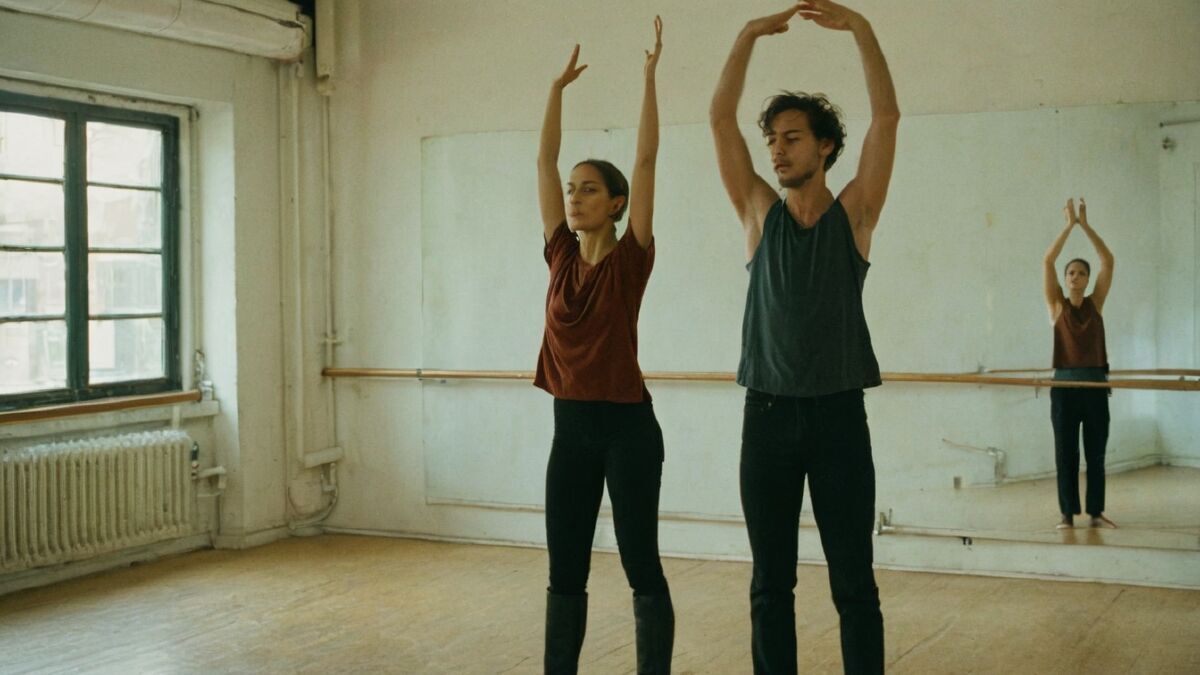
How to Stop Fearing the "Blank Slate"
The primary fear in improvisation is "having nothing to say." Three things can help:
- Rely on Your Partner. Look at them and react to what they are doing. As long as you are reacting, you don't need to "invent" anything.
- Rely on Physical Action. Start doing something with your hands—the text will follow. The body triggers the mind, not the other way around.
- The Right to Pause. Silence in a scene is not a failure. A character who is thinking is more interesting than a character who is rambling.
Improvisation Within a Scripted Scene
On a professional set, you usually cannot improvise the dialogue: the script is approved, audio is being recorded, and the editor needs the takes to match. However, there is still significant room for improvisation:
- Changing your internal objective from one take to another.
- Varying your physical behavior within the blocking.
- Distributing pauses differently.
- Reacting to your partner in new ways.
Before changing any text, always ask the director. "Can I try this in my own words?" is a standard professional question that will be answered with a yes or no.
Common Mistakes
- Denying a partner's offers. This kills the scene instantly.
- Trying to be funny. This distracts from the scene's objective.
- Hogging the scene. Speaking the most does not mean you are improvising the best.
- Abstraction. A lack of concrete details makes the scene feel empty.
- Planning ahead. While you are preparing your next line, you stop hearing your partner.
Summary
- Improvisation is essential for adjustments, group auditions, and when a partner misses a cue.
- Three principles: accept and add, be specific, and prioritize action over wit.
- Solo training focuses on fluency and circumstances; partner training focuses on listening.
- To overcome the fear of silence, rely on your partner, physical action, and the power of the pause.
- On set, improvise your objective and behavior; only change the text with permission.
Please note that specific rates, contract forms, and tax rules vary by market. Projects requiring improvisational auditions can be found in the castings section.
Share


Author: Alexander Shaida, Editor-in-chief
Publication date: August 19 2026
Views: 90
About us and our editorial policy
Comments
Other materials in this section
Learn how to evaluate instructors, what questions to ask before paying, and how to determine if your training is actually delivering results.
Discover the difference between stage combat and martial arts, the skills it provides actors, and the essential safety rules for filming fight scenes.

Discover the real language level required for filming, the difference between speaking and acting in a foreign language, and how to honestly represent your skills.
Discover which dance skills are most requested at auditions, which styles provide the most professional growth, and how to accurately list your level in your profile.

Learn the key differences between stage and screen acting and discover practical exercises to help you get comfortable in front of the lens.
 Auditions in India
 Casting calls in USA
 Castingi w Polsce
 Кастинги в Україні
