Star Trek
To boldly go where no man has gone before
Star Trek (1966-1969)
Сезонов: 3,
серий: 79
Хронометраж серии: 50 min
Средний рейтинг:
8.4/10
116 647



Status
Ended
Country
Телесеть
NBC
Genre
Создатели
Actors
Scenario
Gene L. Coon, D.C. Fontana
Producer
John D. F. Black, Edward K. Milkis, John Meredyth Lucas, Robert H. Justman, Gene L. Coon, Byron Haskin, Fred Freiberger, Gene Roddenberry
Camera operator
Gerald Perry Finnerman
Composer
Editing
Fabien D. Tordjmann, Bruce Schoengarth, Donald R. Rode
Whole Team (150)
Whole Team (150)
Short description
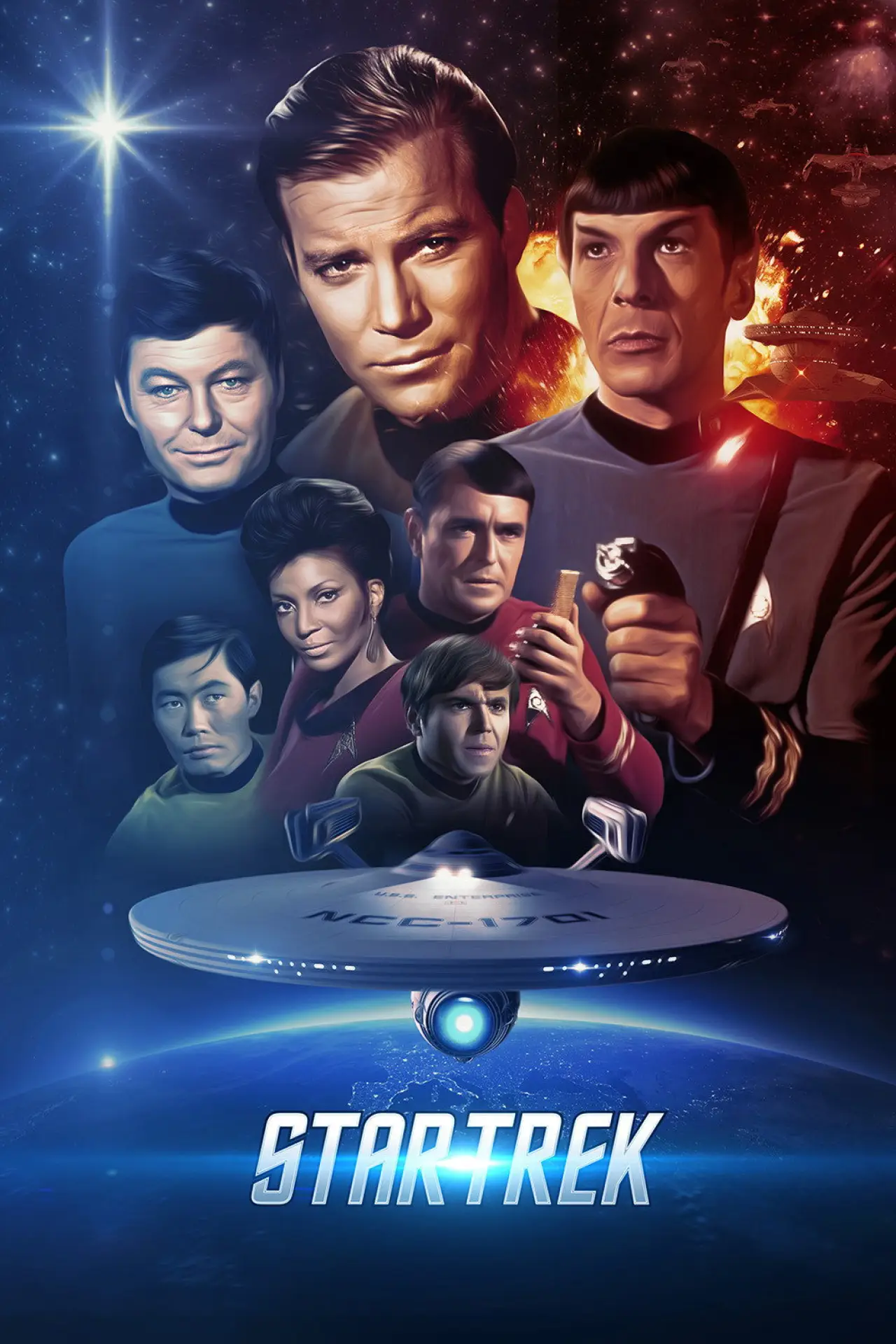
Space. The Final Frontier. The U.S.S. Enterprise embarks on a five year mission to explore the galaxy. The Enterprise is under the command of Captain James T. Kirk with First Officer Mr. Spock, from the planet Vulcan. With a determined crew, the Enterprise encounters Klingons, Romulans, time paradoxes, tribbles and genetic supermen led by Khan Noonian Singh. Their mission is to explore strange new worlds, to seek new life and new civilizations, and to boldly go where no man has gone before.
Seasons
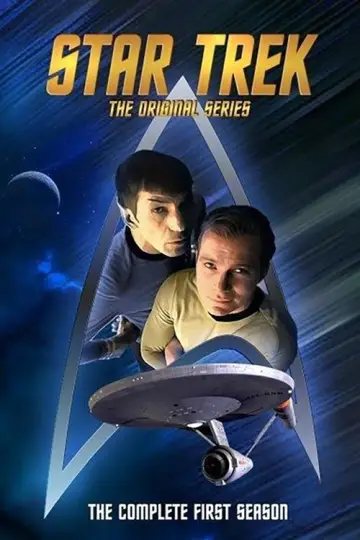
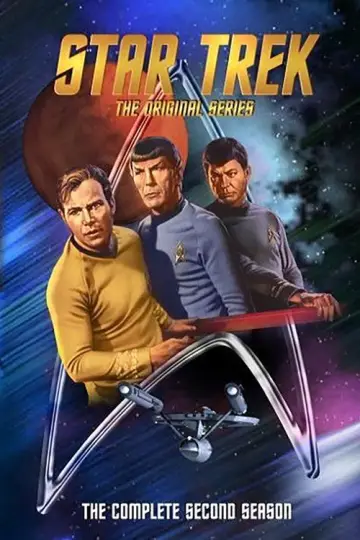
| Season | Episodes | Release date | Rating |
|---|---|---|---|
| 29 | 1966-09-08 | 7.3 | |
| 26 | 1967-09-14 | 7.4 | |
| 24 | 1968-09-20 | 6.9 |
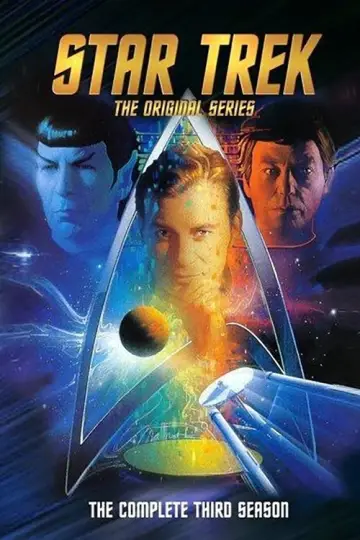
What's left behind the scenes
- For two years, the police searched for items stolen from the set of the television series 'Star Trek,' and she managed to recover only a third of the stolen goods. Along the way, a Batman costume previously stolen from Warner Brothers studios was also found.
- On some of the pipes inside the starship Enterprise, you can see plaques labeled 'K PDK', which stands for 'cinematic flourish, for aesthetics' (kinoshny pont, dlya krasoty).
- Leonard Nimoy's father was a barber when the Star Trek franchise became popular. In an interview with '16' magazine in the mid-1960s, Nimoy Sr. reported that young men often came to him asking for a haircut 'like Mr. Spock.' It never occurred to them that they were being cut by Mr. Spock's own father.
- Leonard Nimoy spoke repeatedly in interviews about how he came up with the Vulcan salute. In one such interview (The A.V. Club website, July 2010), he said: 'The gesture I brought to Star Trek, let's call it the traditional greeting on the planet Vulcan... the idea didn't just come to me out of nowhere. It was in my early childhood. I was 8 years old, at a synagogue with my parents during a service. There is a moment in the ceremony when the Kohanim—a class of priests in Judaism—bless the congregation. The blessing is the same as in the Old and New Testaments: "The Lord bless you and keep you; the Lord make his face shine upon you..." and so on. While the Kohanim are delivering the blessing, you are not supposed to look at them; you must avert your gaze. But I peeked and saw there were five or six of them. They stood with their hands extended toward the believers, and their fingers were spread in this manner. Later, I learned that fingers spread this way form a letter of the Hebrew alphabet.'
- George Takei missed filming for the first nine episodes of the second season because he was filming 'The Green Berets' (1968). During his absence, the character of navigator Pavel Chekov was created, and Takei's intended lines were given to Walter Koenig. Takei recounted that he was seriously angered and did not feel warm toward Koenig at the time. Nevertheless, the actors eventually became good friends.
- After production on the series ended, marketing employees at the NBC television network told management that cancelling Star Trek had been a mistake. The series was described as the most popular in the programming grid in terms of viewer demographics. Management was told that while the series never rose above 52nd place in the overall ratings, the majority of its viewers fell into the 16-to-39 age category—the most desirable demographic for advertisers. In other words, while the series didn't have the highest ratings overall, it attracted exactly the audience every advertiser dreamed of, which alone made Star Trek a very successful project.
- The uniforms of the Enterprise crew came in different colors, which allowed one to determine the wearer's department. Gold denoted the command staff (including navigation and weapons); red denoted operations and maintenance (including engineering, security, and support services, such as communications); blue denoted the science departments (including medical). The red uniforms did not appear in the very first episodes; Uhura and Scott were filmed in gold. In reality, the gold uniforms sometimes looked green (some attributed this to poor television signal reception). The command uniforms were actually green, but appeared gold due to the lighting on the set. The true color of the command uniform can be seen in Captain Kirk's jacket and in the dress jackets occasionally worn by crew members. They are made of materials that reflect light differently. Between shoots, the uniforms were dry-cleaned, and since the velour shrank, the jackets had to be hemmed periodically. This is why viewers sometimes got the impression that a particular character's uniform jacket was simply too small.
- When advertising the series 'Star Trek' (1966) in magazines, NBC employees carefully retouched Spock's eyebrows and ears, fearing they would alienate potential audiences due to his alleged resemblance to the devil. These fears proved unfounded, as Spock became one of the most popular characters and a sex symbol for young female viewers, which was unexpected for both the series creators and the actors themselves.
- The phrase 'I'm a doctor, not a...' from the series is taken from the film 'The Kennel Murder Case' (1933). The forensic expert in the film, played by Etienne Girardot, repeatedly insists that he is a doctor, not a journalist, not a detective, and so on.
- Nyota Uhura became one of the first permanent Black characters in television series. She preceded the appearance of Diane Carroll as a young widowed nurse and single mother in the sitcom 'Julia' (1968-1971) by two years. The significance of this character was heightened by the fact that the series creators and the actress managed to avoid many of the stereotypes associated with African Americans in television programs of that period. Nichelle Nichols, who played Uhura, once confessed that Martin Luther King Jr. himself told her that she simply had to continue in the role, as positive Black characters were almost non-existent on television. In an interview for the documentary 'Trekkies' (1997), Nichols said that at least one person later confirmed King's correctness. When actress Whoopi Goldberg (who would appear in the series herself in 1987) first watched 'Star Trek' (1966), she shouted, 'Mom, there's a Black lady on TV, and she's not a maid!' In a 2011 interview with the non-profit organization 'StoryCorps', Carl McNair (brother of Ronald McNair, the second Black astronaut and one of the seven who perished in the Challenger shuttle explosion on January 28, 1986) recalled the impression 'Star Trek' made on his brother. He said: 'Star Trek showed us a future where Black and white people work side by side. I viewed it as science fiction because I didn't believe it would ever be possible. Ronald, however, thought it was quite likely. He grew up in the years when Neil Armstrong and those guys were flying. How could a colored boy from South Carolina, who wore glasses and had never flown a plane, dream of space? But that's how Ronald was. He refused to accept the existing order of things. He let others think he was abnormal. And so he ended up aboard his own starship, Enterprise.' Starting in the mid-1970s and into the 1980s, Nichols, as the first Black woman 'in space,' assisted NASA with its program to recruit women into the astronaut corps. Specifically, Astronaut Group 8 (for which Nichols helped recruit candidates, with selection ending in January 1978) included Air Force Colonel Guion Bluford (the first African American in space), Dr. Judith Arlen Resnik (the first American woman of Jewish descent in space), and Dr. Ronald McNair. Four members of this group—Resnik, McNair, Ellison Onizuka, and Francis Richard 'Dick' Scobee—died in the Challenger disaster on January 28, 1986. The credits of the film 'Star Trek IV: The Voyage Home,' released that same year, began with a dedication to the tragically lost crew of the Challenger.
- Leonard Nimoy based Spock on actor George Burns and his ubiquitous cigar. The model for the relationship between this character and Dr. McCoy was Burns' relationship with Gracie Allen (specifically, his ironic attitude toward her tirades).
- Gene Roddenberry created the characters of Uhura and Christine Chapel specifically for actresses Nichelle Nichols and Majel Barrett. Both actresses had been in a relationship with Roddenberry when he was conceiving 'Star Trek'. Nichols broke up with him shortly after work on the series began, while Barrett eventually married him and remained Roddenberry's wife until his death.
- In 2000, 'Star Trek' was entered into the Guinness World Records as the franchise with the highest number of spin-offs, including both feature films and television series.
- According to their wills, the ashes of Gene Roddenberry and James Doohan (who played Scotty in the television series) were launched into space in 1997 in a special capsule aboard a Pegasus rocket.
- Initially, Gene Roddenberry planned to make the Klingons look much less human than they appear in the series, but it turned out that this would be quite expensive. The metallic tint was only added to the Klingons' skin in the third season. When the films began to be produced years later, their budgets and the requirements of cinema finally allowed Roddenberry to bring his visions to the screen. Roddenberry jokingly commented on the difference between the Klingons in the original 'Star Trek' and other projects in the franchise as the 'difference between Northern and Southern Klingons.' Within the projects themselves, this discrepancy received various explanations. In the episode 'The Trouble with Tribbles' from the series 'Star Trek: Deep Space 9' (1993–1999), where the characters travel to the past, Doctor Bashir and Miles O'Brien suggest that the changes in the Klingons' appearance are the result of genetic engineering or a viral mutation. According to Worf, '...this is not a subject that Klingons discuss with outsiders.' In the fourth and final season of the series 'Star Trek: Enterprise' (2001–2005), the viewer is offered an explanation that combines both of these hypotheses into one.
- According to producers Herbert F. Solow and Robert H. Justman, William Shatner, who is only 175 centimeters tall, wore high-soled shoes to appear taller than Leonard Nimoy. In such shoes, Shatner stood over 180 centimeters tall. Unfortunately, this had such a negative effect on his posture that Gene Roddenberry eventually forbade the actor from using these tricks, ordering Nimoy and DeForest Kelley to wear low-soled shoes instead.
- Mark Lenard, who played the role of Sarek (Spock's father), became the first actor to portray representatives of three major alien races: a Romulan starship captain (in the 1966 episode "Balance of Terror" of the television series "Star Trek: The Original Series"), a Vulcan ambassador and Spock's father (in the 1967 episode "The Way to Babylon" of the same series and several other episodes), and a Klingon starship captain (in the 1979 feature film "Star Trek").
- Leonard Nimoy's makeup had a greenish tint because the inhabitants of the planet Vulcan have green blood. The makeup was mixed by hand every time, so the shade varied in visibility from one episode to another, and in many shots (especially close-ups), it is not visible at all.
- George Takei claimed that his role and the number of his lines were cut due to William Shatner's "diva behavior." Shatner himself always denied this, and the relationship between the actors deteriorated following Takei's statement. Norman Spinrad, a science fiction writer and screenwriter for one of the episodes, later explained that Shatner was contractually entitled to dominate the screen and that the lines of other actors were indeed cut in Shatner's favor.
- Had "Star Trek" been renewed for a fourth season, the producers would have introduced Koloth from the episode "The Trouble with Tribbles" (1967) as a recurring antagonist. Roger S. Carmel would have played Harry Mudd for a third time, and McCoy's daughter, Joanna, would have appeared on screen for the first time.
- The Enterprise's engineer, Scotty, is named Montgomery Scott. The character's name was created by James Doohan and Gene Roddenberry. "Scott" was chosen as the surname because Roddenberry liked Doohan's Scottish accent, and "Montgomery" was James Doohan's middle name.
- James Doohan's son recently attempted to buy a life-size statue of his father at an auction held by a Hollywood wax museum, but an anonymous Star Trek fan offered a higher price.
- In this series, the characters Sulu and Uhura were introduced without first names, referred to only by their surnames. Sulu had a name (Hikaru) in the books the series was based on, but it was not spoken on screen until the feature film "Star Trek VI: The Undiscovered Country" (1991). In the bonus materials of the Season 2 DVD of "Star Trek," Nichelle Nichols explained that she and Gene Roddenberry gave her character the name Nyota (sometimes Niota), which means "star" in Swahili. "Uhura" is a slightly modified version of the word "uhuru," which also translates from Swahili as "freedom." In the 1969 book "The Making of Star Trek" by Steven J. Whitfield and Gene Roddenberry, this character was given the name "Penta." For unknown reasons, numerous fans of the franchise refused to accept this name, even though the book was considered an authoritative source for them. The name Nyota was first spoken on screen in the 2009 feature film "Star Trek" produced by Paramount Pictures.
- The glow of the operating transporter field was created as follows: an industrial fan blew aluminum powder into the air, which was then illuminated by powerful spotlights.
- In "Star Trek," the arrowhead-styled insignia could only be seen on the uniforms of the Enterprise crew. The insignia on the uniforms of Starfleet officers visiting the starship were different. Officers of the rank of Commander wore a star-shaped badge with radiating rays. By the time the franchise hit the big screen ("Star Trek: The Motion Picture," 1979), the stylized arrowhead became the official symbol of the entire Starfleet and remained so in all subsequent films and spin-offs. The only exception was the series "Star Trek: Enterprise" (2001-2005), which takes place before the events described in "Star Trek."
- While working on "Star Trek: The Original Series," Gene Roddenberry instructed one of the scriptwriters, named Fontana, to use only the initials D.K. This refers to Dorothy Katherine Fontana. In those years, television networks were reluctant to accept scripts written by women, a fact of which Roddenberry was well aware.
- Leonard Nimoy, who played Spock, became the only actor to appear in all 80 episodes of Star Trek, including the pilot episode "The Cage," which was rejected in 1965 and did not air until 1988.
- The turbolift doors on the starship were opened and closed by stagehands who pulled ropes attached to the doors. These same workers moved images of various Enterprise decks past the lift to create the illusion of motion. On several occasions, actors walking at full speed ran into closed doors because a stagehand had become distracted and missed the director's signal. At Star Trek fan conventions, a reel is often shown, edited from clips where William Shatner walks full tilt into a door that failed to open in time and begins to swear.
- In at least two episodes of Star Trek ("Miri" in 1966 and "The City on the Edge of Forever" in 1967), sets from the fictional town of Mayberry from "The Andy Griffith Show" (1960-1968) were used. In a scene from the second episode where Kirk walks Edith home, one can see the easily recognizable courthouse, Floyd's Barber Shop, Emmett's workshop, and a small store from the CBS sitcom.
- The Klingons are the creation of screenwriter Gene L. Coon. Their first on-screen appearance occurred in the episode "Errand of Mercy," which premiered on March 16, 1967. The race owes its name to Lieutenant Wilbur Klingen, with whom Star Trek creator Gene Roddenberry once served in the Los Angeles Police Department.
- One of the Starfleet directives states that the technology of the United Federation of Planets must not fall into the hands of primitive races, and that natives must not even suspect the existence of an advanced Earth civilization. Nevertheless, there are many episodes in the series in which the crew of the Enterprise leaves communicators, phasers, and other modern equipment on underdeveloped planets.


 Auditions in India
 Casting calls in USA
 Castingi w Polsce
 Кастинги в Україні
