The Thief and the Cobbler
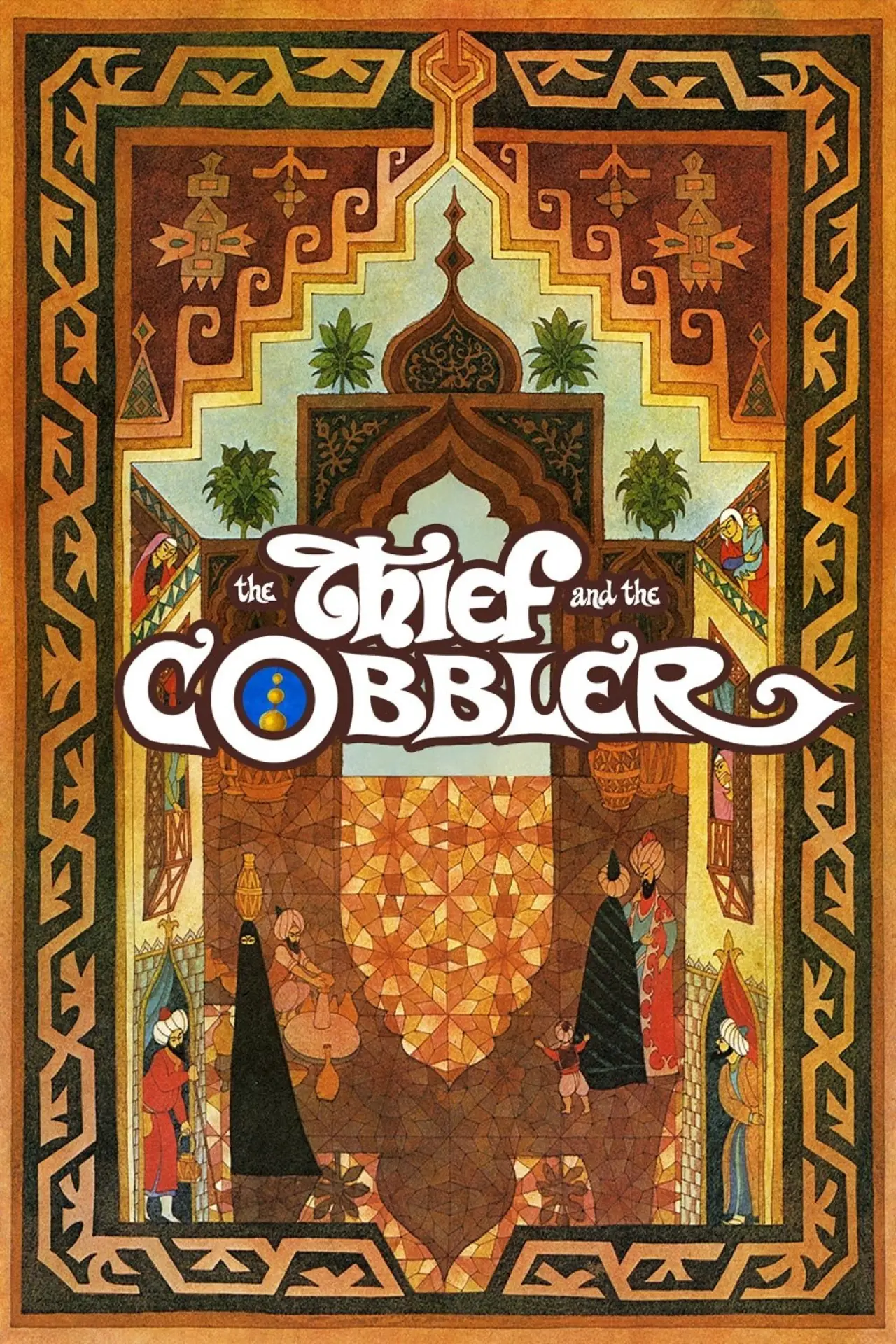
Long before Aladdin, ages before Ali Baba, came the hilarious adventure of a simple shoemaker who saved an enchanted kingdom, won the heart of a beautiful princess, and became the first Arabian Knight.



Country
Budget
$25 000 000
Box office
$669 276
Director
Actors
Scenario
Producer
Camera operator
John Leatherbarrow
Composer
Artist
Audition
Editing
Peter Bond
Whole Team (33)
Whole Team (33)
Short description
Princess Yum Yum falls in love with Tack and saves him from being executed. Later, when the protective orbs of the palace get stolen, Tack and Yum Yum set out to find them and save the kingdom.
What's left behind the scenes
- In the 1960s, the entire project was conceived as an adaptation of the adventures of Hodja Nasreddin. Richard Williams had once illustrated a book about Nasreddin by Idris Shah (1924-1996) and decided to adapt it for the screen. This plan came to an end in 1972 when Shah threatened Williams with a lawsuit for copyright infringement. Williams cut the entire Nasreddin storyline from the project and continued working on the remaining material, renaming the project 'The Thief and the Cobbler.' Nasreddin does appear on screen in one short episode; he is seen riding a donkey backward as Zigzag enters the city.
- In 1978, Mohammed bin Faisal Al Saud of Saudi Arabia showed interest in the film and agreed to finance a 10-minute clip costing $100,000. Richard Williams jumped at the offer, but he missed the deadline twice, and the clip—which ended up costing $250,000—was not ready until the end of 1979. Al Saud refused any further cooperation with Williams.
- Excluding animal deaths, the unedited 90-minute version of the film depicts over 1,000 deaths; the 80-minute version, released as 'The Princess and the Cobbler,' features 98; and the 72-minute 'Arabian Nights' by Miramax Films counts 54 deaths.
- The animated film took 29 years to create. This is an absolute world record.
- The original script included a scene in which Zigzag summons a giant dragon to destroy the city, but the Young Shoemaker defeats the dragon. This scene had to be scrapped due to the complexity of its animation.
- Richard Williams demanded animation at 24 frames per second, whereas the standard for cartoons was half that. This approach required more time and money, and if the animators failed to submit a section by the deadline, Williams would fire the entire team. As difficult as it was to work with Williams, everyone was shocked when he was replaced by Fred Calvert. Calvert was more than indifferent toward animation. He re-edited existing material, cutting out a great deal and filling the gaps with hastily and poorly drawn segments. The animators who had started the project were shocked to learn that he ordered some already completed scenes to be redrawn just so the quality would match what had been produced under his leadership. Ultimately, more money was spent ruining the film than if the studio bosses had simply allowed Williams to finish it.
- The shimmering effect surrounding the gemstones and fountains on screen was achieved by filming through a lens covered in cellophane film and using interchangeable filters.
- Richard Williams hoped to make the greatest animated film of all time, and gradually, working on it became the meaning of his entire life. Unable to find private investors willing to invest in his brainchild, Williams decided to raise the necessary funds himself, taking on the creation of television commercials and drawing short animated films for Sunday morning broadcasts. Soon, Robert Zemeckis invited Williams to be the animation director for his project, 'Who Framed Roger Rabbit' (1988). Following the success of the project, for which Williams received two Oscars, Warner Bros. agreed to finance and distribute Williams' own film. Soon, however, it became clear that Williams would not meet the studio's deadlines (1991). In 1992, 'Aladdin' was released, whose plot and style closely resembled those of 'The Thief and the Cobbler' (they were worked on by the same animators). Shortly thereafter, Williams was removed from the project, which was handed over to the Completion Bond Company and producer Fred Calvert for rapid completion. Calvert filmed many additional scenes, significantly altered the script, and ordered the main characters to be redubbed. Before the film's theatrical release, it was edited and shortened again by Miramax. Pirated copies of the director's cut exist, but it has not yet been officially released.
- To voice the bandits, Richard Williams requested a group of voice actors of Irish descent. He provided them with drinks, turned on a tape recorder, and gave the actors a script, which they read while becoming increasingly intoxicated. It ended with the actors fighting among themselves, but Williams got what he wanted and subsequently included those voices in the film.
- Richard Williams maintained strict discipline in the studio and repeatedly fired animators who had committed some sort of infraction.
- In the original version, the Great One-Eye was voiced by Paul Matthews, an ordinary courier who had once ridden an elevator with Richard Williams. Matthews had no acting skills, of course, but Williams hired him anyway.
Similar movies
8.6/10
8.2/10
8.2/10
8.2/10
8.1/10
8.1/10
8.1/10

8.1/10
8.1/10
8/10


 Auditions in India
 Casting calls in USA
 Castingi w Polsce
 Кастинги в Україні
