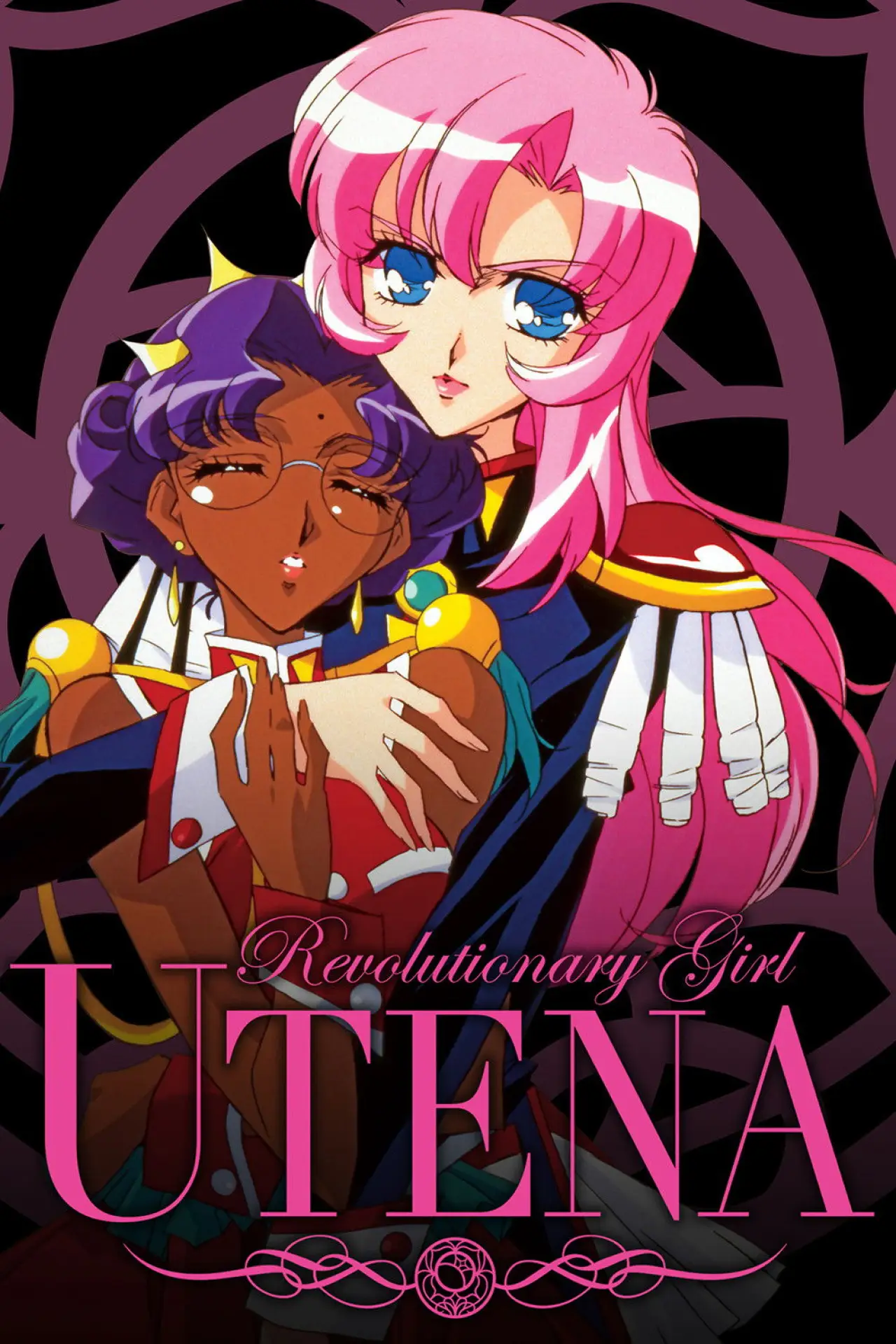
Revolutionary Girl Utena
The power to revolutionize the world!
少女革命ウテナ (1997)
Сезонов: 1,
серий: 39
Хронометраж серии: 24 min
Средний рейтинг:
7.8/10
4 846



![Видео к сериалу Revolutionary Girl Utena — Opening | Rondo-Revolution - Masami Okui [Subtitled]](https://www.acmodasi.com/amdb/images/tv/posters/0/10/revolutionary-girl-utena-1997-AylXC.webp)
Status
Ended
Country
Телесеть
TV Tokyo
Production
Genre
Actors
Scenario
Yoji Enokido, Ryoe Tsukimura
Producer
Camera operator
Toyomitsu Nakajo
Composer
Shinkichi Mitsumune
Editing
Short description
"Never lose that strength or nobility, even when you grow up." When Utena was just a child and in the depths of sorrow, she found salvation in those words. They were the words of a prince, who bestowed upon her both a ring and the promise that it would lead her to him again. She never forgot the encounter. Now a teenager, Utena attends the prestigious Ohtori Academy; however, her strong sense of chivalry soon places her at odds with the student council and thrusts her into a series of mysterious and dangerous duels against its members.
Seasons
| Season | Episodes | Release date | Rating |
|---|---|---|---|
| 39 | 1997-04-02 | 6.6 |
What's left behind the scenes
- The chorales heard during the duels in episodes 14 and 20 are written in archaic Japanese used before the 16th century. Most modern Japanese people do not understand it unless they have studied it specifically.
- Episode 6 was originally intended to be episode 8, and episode 8 was meant to be episode 6; however, because episode 6 ("Journey for Curry") could not be completed in time, it was decided to swap it with episode 8 ("Be Careful, Nanami!").
- The Japanese version of Sholem Secunda's song "Donna Donna" is performed in several episodes of the series.
- The scene in episode 23, where Mamiya stands with flowers next to Mikage lying on the bed, references two famous works of art: Édouard Manet's "Olympia" and Titian's "Venus of Urbino".
- The phrase spoken by the Student Council members before every meeting is a reference to Hermann Hesse's "Demian": "The bird fights its way out of the egg. The egg is the world. Who would be born must first destroy a world. The bird flies to God. The God's name is Abraxas." The title of one of the soundtrack tracks, "Legend: The God's Name is Abraxas," is also a reference to "Demian."
- In the episode "Nanami's Egg," it was originally planned to use Ayumi Ishida's famous song "Yokohama Blue Lights," which was particularly popular in the late 1960s. Due to copyright issues, this idea had to be abandoned.
- Shiori's appearance is a reference to a character from the little-known manga "Himegoto no Natsu" by Chiho Saito.
- The first title of the project, conceived in 1994, was "Queen Utena Who Births a Dragon from Her Breast".
- In early versions of the script, Utena and Himemiya were the same character.
- Utena originally had short hair and bore the surname Haruka. Her long hair in the series is the result of a sponsor's suggestion.
- In episode 31, during the dialogue between Utena and Nanami in the park, Giovanni Lorenzo Bernini's "The Rape of Proserpina" and Gerhard Marcks' "Town Musicians of Bremen" can be seen among the sculptures appearing in the foreground.
- Be-Papas members mentioned that while planning the series, Kunihiko Ikuhara thought of adding elements of the Takarazuka style to the work. This led to the creation of the lead character—a girl in men's clothing—and gave the overall style of the work a more theatrical feel.
- Director Shūji Terayama was one of Kunihiko Ikuhara's childhood idols. Be-Papas members have mentioned several times that Terayama's avant-garde style strongly influenced the visual imagery of 'Utena'.
- In his youth, Kunihiko Ikuhara was a fan of J.A. Seazer's work. While working on the series, he approached the composer for permission to use some of his pieces in the 'Utena' soundtrack; however, Seazer was so inspired by the director's vision that he decided to collaborate with him and write new chorales for each of the duels in the series and movie.
- The series' aesthetics are heavily influenced by Riyoko Ikeda's manga and their adaptations. From there come the references to the French language, the rapiers, the duels, and the Baroque graphics.
- In one of his interviews, Kunihiko Ikuhara stated that one of the artistic goals he set for himself was to draw the audience's attention to the Japanese language (and Japanese literature). Consequently, the series is rich in quotations and complex wordplay and meanings, while the chorales by the renowned Japanese choir master J.A. Seazer used in the musical score were intended to showcase the beauty of the Japanese language's sound.
- It was originally planned that Himemiya would fight in the duels herself during the second arc.











 Auditions in India
 Casting calls in USA
 Castingi w Polsce
 Кастинги в Україні
