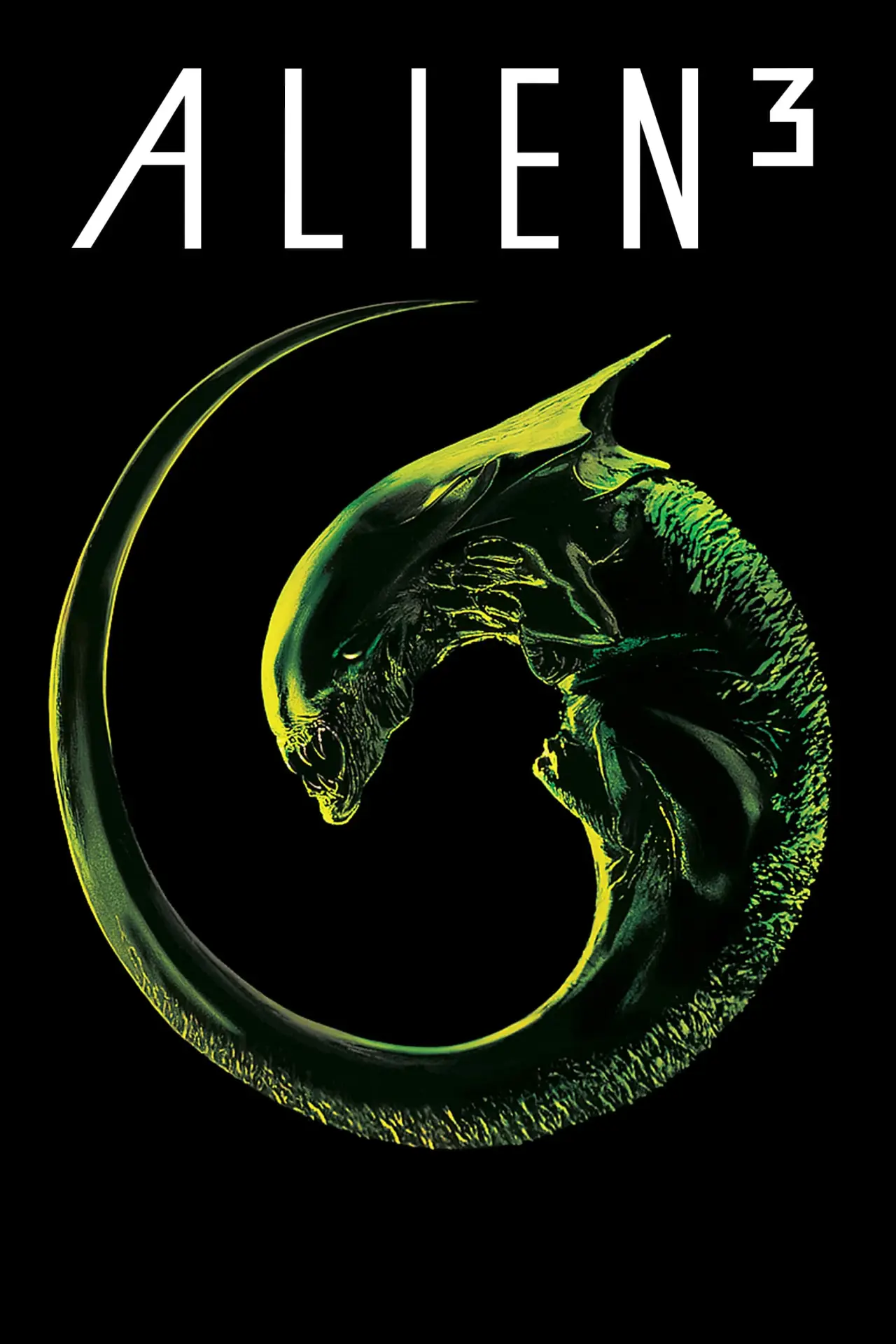
Alien³
3 times the suspense. 3 times the danger. 3 times the terror




Country
Production
Genre
Budget
$50 000 000
Box office
$159 773 545
Director
Actors
Scenario
Producer
David Giler, Walter Hill, Gordon Carroll, Ezra Swerdlow
Camera operator
Alex Thomson
Composer
Artist
Norman Reynolds, Jonathan McKinstry
Audition
Billy Hopkins, Priscilla John
Editing
Terry Rawlings, David Crowther, Patricia Carr
Whole Team (161)
Whole Team (161)
Short description
After escaping with Newt and Hicks from the alien planet, Ripley crash lands on Fiorina 161, a prison planet and host to a correctional facility. Unfortunately, although Newt and Hicks do not survive the crash, a more unwelcome visitor does. The prison does not allow weapons of any kind, and with aid being a long time away, the prisoners must simply survive in any way they can.
What's left behind the scenes
- Renny Harlin was originally intended to direct the film, but he left the project to shoot the sequel to 'Die Hard' (1988). Vincent Ward was then listed as the film's director, but he was fired several months later due to creative differences with the producers. Screenwriter Walter Hill was also considered for the director's position, but he declined when David Fincher was offered the opportunity to direct the film.
- Two weeks after filming began, Alex Thomson replaced Jordan Cronenweth as cinematographer due to the latter's illness.
- Sigourney Weaver's character, Ripley, was absent in early script drafts.
- The appearance of the Alien was not initially planned in the original script.
- After the first draft of the script was completed (which took place in a monastery), construction of the sets began. As the script was constantly being rewritten, the work was halted. Despite the final version of the script taking place in a prison, some of the half-finished monastery sets were used for filming.
- In the script written by William Gibson, Ripley spent most of the time in a coma.
- Because the initial script versions took place on Earth, one of the early taglines for the film was: “On Earth, everyone can hear you scream.”
- If you translate the Hungarian title of the film back into English, you get “Final Solution: Death.”
- The comic book series released within the film universe took place several years after the events of “Aliens.” A grown-up Newt and Hicks try to prevent the Weyland Yutani corporation from acquiring a Xenomorph specimen. The comics were republished to coincide with the theatrical release of “Alien 3” (1992).
- After completing filming, David Fincher left the project, citing the studio's constant interference in the creative process. He did not participate in the film’s editing.
- One of the early ideas for the film involved a Xenomorph bursting from the chest of Michael Biehn’s character, Hicks. A model of Hicks with a torn chest was even created, but after Biehn found out about it, he threatened to sue the producers for using the model without his consent. The producers ultimately abandoned the idea, but paid Biehn for the use of his photographs in the film. According to unconfirmed reports, Biehn received more money for his photographs than he did for his role in “Aliens” (1986).
- Dr. Clemens’s phrase about Fury-161, “…a prison planet belonging to Weyland Yutani,” is the first spoken mention of the Company’s name. Previously, the Company’s name could be seen on various equipment and computer monitors, but the characters always referred to the company simply as “the Company.”
- The role of Clemens was offered to Gabriel Byrne.
- Off-set, Sigourney Weaver had to wear a wig because her two-year-old daughter really disliked her bald mother.
- In this film, the Xenomorph differs from its counterparts in previous installments: it has more pronounced lips and lacks organic tubes on its back.
- The film’s editing process lasted approximately one year.
- A cross can be seen on the planet's surface, symbolizing the religion adopted by the prisoners. The set decorators created four models of the cross, after which David Fincher chose one of them.
- Most of the factory set was made of cardboard.
- H.R. Giger designed the appearance of the alien, which resembled a puma with claws. Producers also asked him to make the alien models more sexual. Giger proposed a model of an alien with feminine lips. One of his ideas was that the alien kisses its victim, thereby killing her. This idea was used in the film 'Species' (1995), where the appearance of the alien creature was also designed by Giger.
- Vincent Ward used his fee for working on this film to finance his next film, 'Map of the Human Heart' (1992).
- Eric Red, David Twohy, John Fasano, and Rex Pickett wrote their own versions of the film's script. Their work is now readily available online.
- At one stage of the project's development, various plot options were considered that did not include Ripley. However, some time later, Joe Roth (then president of 20th Century Fox studio) stated that the sequel would only be made if Sigourney Weaver's character returned.
- In 2004, 20th Century Fox released a special edition of all four films on DVD – “Alien Quadrilogy.” The studio really wanted David Fincher to edit his own version of the film and record commentary for it, but Fincher refused. Fincher is the only director of the Alien films who refused to have anything to do with the project after filming was completed.
- The special 2003 version has a runtime of 145 minutes.
- $13 million was spent on sets that were not used in the film.
- Sigourney Weaver initially had little desire to appear in sequels and only agreed to a small cameo.
- Gailer and Hill tried to sign Ridley Scott as director, but he had to decline due to being overcommitted (he had three projects in development at the time).
- Initial ideas ranged from Aliens landing on Earth and mutating into super-monsters destroying New York, to Ripley and a grown-up Newt hunting a new type of Alien in a metropolis in the style of 'Blade Runner' (1982).
- The first writer brought onto the project was William Gibson, now considered the father of cyberpunk. In the fall of 1987, he began writing a screenplay based on the idea of Gailer and Hill. By December 1987, he had completed a first draft of 140 pages. Gibson's screenplay reveals a world with two powerful centers of power: the Weyland-Yutani Corporation and the government subordinate to it, and the Union of Progressive People, a kind of space-based successor to the USSR and the Warsaw Pact organizations. The screenplay was written when Sigourney Weaver's participation in the film was uncertain, so Hicks and Bishop (characters from 'Aliens' (1986)) were at the forefront of the plot. The only thing that remained of Gibson's ideas in 'Alien 3' was the prison numbers on the necks of the inmates.
- Initially, Rex Pickett, hired to help David Fincher rework the script, was only supposed to fix the second half, written by Guyler and Hill – but time was running out catastrophically before filming began, and he ended up rewriting almost the entire script, piecing it together from previous versions. After agonizing deliberation, it was decided to finally abandon the wooden planetoid and 'alien-mutants' and return to the theme of Twy's script, replacing the monastery with a prison and the monks from Ward's script with prisoners. Some of the monastery sets were repurposed for the prison, while another part (worth 7 million) remained unused. In the rush, no one was bothered by questions about how the 'alien' egg got onto the 'Sulaco' and other logical inconsistencies – the only thing that mattered was to write something coherent in order to film the movie by the long-announced premiere date.
- Once the script was ready, instead of gratitude, Guyler and Hill, and its author Rex Pickett, were fired, apparently deciding that they could manage on their own, and as a result, Pickett didn't even receive a mention in the credits.
- When the first teaser for 'Alien 3' was released (made in the spirit of the classic trailer for Scott's film), it was preceded by the following tagline: 'In 1979, you learned that in space no one can hear you scream. In 1992, you will learn that on Earth everyone will hear your scream' – which, of course, was a lie, because at that point everyone on the set knew that the action would not take place on Earth.
- A question arose regarding the credits – because according to the rules of the Writers Guild, the authors of the script and the idea had to be indicated, and ultimately, after lengthy disputes, it was decided to include David Guyler, Walter Hill, and Larry Ferguson as screenwriters, and separately Vincent Ward as 'story author'.
- H.R. Giger created the iconic look of the 'alien'. Fincher really wanted to involve the Swiss artist in the work on the third installment, and he readily agreed, drew and faxed several sketches of the new monster, and even made a full-scale, two-meter model of the 'alien' at his own expense, offering it to the studio practically for free (at the cost of the materials used). However, things didn't go further than that – without explanation, the studio and Fincher refused Giger's services, severed all ties with him, and didn't even include his name in the credits, forcing the Swiss artist to sue the filmmakers.
- The construction of a huge lead factory on the 'Pinewood' studio lot took 3 months.
- Operator Jordan Cronenweth had to leave the project three days after filming began, as he was diagnosed with Parkinson's disease. He died in 1996.
- In total, about a dozen different drafts were written during the autumn-early winter of 1990, containing many alternative scenes and plot twists. Here are some of them: 1. In one of the scripts, the character Dillon was named Malcolm. 2. The Facehugger infected Newt. After the crash landing, the Alien embryo crawled out of the mouth of the drowning Newt, then jumped onto Ripley and implanted itself inside her. 3. In several versions of the script, the Alien inexplicably didn't harm the prisoner Golik, and he began to "help" it, hunting other prisoners. In one draft, Golik met representatives of the Company in the finale and led them to Ripley, but then mistakenly decided Bishop II was a droid, saying "I hate droids," killed him, and was killed by security gunfire. In another draft, the Alien did cocoon Golik, and he was later found in that state by the heroes. 4. In yet another scenario, there was a scene where Ripley and Dillon found about a dozen prisoners cocooned. Dillon set them on fire, after which the Alien appeared and killed Dillon. After that, until the end of the script, the guard Aaron helped Ripley, performing roughly the same functions as Dillon in the final film. The production team even began making 20 cocoons, but after Fincher joined the project, he abandoned this idea, deciding that in his version the Alien would only kill for sustenance. Nevertheless, he left one of the cocoons and often sat in it during filming, claiming that he "thought better" in it.
- In Vincent Ward's script, which received the green light, the action took place on the planetoid 'Arseon'. On this planetoid was a giant wooden monastery built by the Company and surrounded by a vast sea. The monastery was inhabited by 350 monks who believed they lived in a post-apocalyptic Middle Ages. The monks did not recognize any modern technology, and their way of life was no different from the Middle Ages. When Ripley's shuttle landed on the planetoid, the monks accused her of being responsible for the Alien invasion of their land. Ripley was pregnant with an Alien, so to speak, in a traditional way. Therefore, she was pregnant with an Alien-human hybrid. Ward left the project after the producers insisted he replace the monks with prisoners and abandon the idea of using a wooden monastery.
- In late 1991, due to constantly arising difficulties, filming was halted at 'Pinewood Studios' (England) and moved to Los Angeles. One of the scenes that needed to be filmed was the scene of the Alien being killed in a lead pool. Sigourney Weaver was once again required to shave her head. She agreed, but only if she was paid an additional $40,000. The producers rejected her offer and hired Greg Cannom to create a special wig. The wig cost $16,000 and took a lot of time and effort to create.
- Initially, the bull was intended to be the animal carrying the embryo of the Alien. Later, the creators decided to abandon this idea. However, the original scenes were restored and included in the director's cut (Assembly Cut).
- To create the body of Rebecca (Newt), the filmmakers used a life-size Carrie Henn doll, made specifically for the filming of 'Aliens' (1986).
- After David Fincher had a falling out with the producers, he was denied the opportunity to film the climactic scene of the film where Ripley and the Alien come face to face. Despite the ban, Fincher filmed the scene. His version was used in the final editing of the film.
- Fincher was not allowed to film an important scene, in his opinion, with Ripley and the Alien in the prison basement. Fincher took Weaver and the camera and secretly filmed this scene. It can be seen in the director's cut.
- Approximately 40 minutes of material was cut from the theatrical version. For example, a scene where the prisoners manage to trap the Alien in a storage room and later release it by Golic was removed – the producers felt this made the Alien not scary enough. Because of this, the entire subplot involving Golic also had to be removed. In addition, alternative scenes of the Alien's birth and an alternative ending, where the Alien bursts from Ripley's chest during a jump, were used.
- The crane that lifts the lifeboat out of the water was constructed from various parts of an X-Wing fighter from "Star Wars".
- Sigourney Weaver's contract included a special clause stating that Walter Hill and David Giler were required to write the film's screenplay. According to Weaver, Ripley is a complex character, and only James Cameron, Hill, and Giler managed to fully reveal this character.
- Renny Harlin was originally intended to direct the film, but he left the project to film the sequel to 'Die Hard' (1988). Vincent Ward was later listed as the director, but he was fired a few months later due to creative differences with the producers. The film's screenwriter, Walter Hill, was also considered for the director's post, but he declined the position once David Fincher was offered the job.
- Two weeks after filming began, cinematographer Alex Thomson replaced Jordan Cronenweth due to the latter's illness.
- Sigourney Weaver's character, Ripley, was absent from early versions of the script.
- After the first draft of the script (in which the action took place in a monastery) was completed, the construction of the sets began. Since the script was being constantly rewritten, work was halted. Despite the fact that the final version of the script is set in a prison, some of the half-finished monastery interior sets were used for the filming of the movie.
- In the script written by William Gibson, Ripley spent most of her time in a coma.
- Because the early drafts of the script were set on Earth, one of the film's early slogans was the phrase: "On Earth, everyone can hear you scream."
- If you translate the Hungarian title of the film back into English, it becomes "Final Solution: Death."
- In a series of comics released based on the film series universe, the action took place several years after the events of "Aliens." An adult Newt and Hicks attempt to stop the Weyland Yutani Corporation from acquiring an Alien specimen. The comics were reissued by the time "Alien 3" (1992) hit theaters.
- After filming was completed, David Fincher left the project, citing the studio's constant interference in the creative process. He did not participate in the editing of the film.
- One of the early ideas for the film involved an Alien emerging from the chest of Michael Biehn's character, Hicks. A model of Hicks with a torn chest was even created, but after Biehn found out, he threatened to sue the producers for using the model without his consent. The producers eventually abandoned the idea but paid Biehn for the use of his photographs in the film. According to unconfirmed reports, Biehn received more money for his photos than for his role in the movie 'Aliens' (1986).
- Dr. Clemens' line about Fury 161—“...a prison planet owned by Weyland-Yutani”—is the first time the Company's name is mentioned aloud. Previously, the Company's name could be seen on various equipment and computer monitors, but the characters always referred to it simply as 'the Company'.
- Off-set, Sigourney Weaver had to wear a wig because her two-year-old daughter really disliked seeing her mother bald.
- A cross can be seen on the planet's surface, symbolizing the religion adopted by the prisoners. The set decorators created four cross models, from which David Fincher chose one.
- H.R. Giger developed the appearance of the alien, which resembled a puma with claws. The producers also told him to make the alien models more sexual. Giger proposed an alien model with female lips. One of his ideas was for the alien to kiss the victim, thereby killing them. This idea was used in the film 'Species' (1995), where the appearance of the extraterrestrial creature was also designed by Giger.
- Vincent Ward used his fee for working on this film to finance his next picture, 'Map of the Human Heart' (1992).
- Sigourney Weaver's contract included a special clause stating that the screenplay had to be written by Walter Hill and David Giler. According to Weaver, Ripley is a complex character, and only James Cameron, Hill, and Giler managed to fully realize her.
- Eric Red, David Twohy, John Fazano, and Rex Pickett wrote their own versions of the film's screenplay. Their works can now be easily found on the internet.
- During one of the project's development stages, various plot options were considered in which Ripley was absent. However, some time later, Joe Roth (then president of 20th Century Fox) stated that a sequel would only be filmed if Sigourney Weaver's character returned.
- In 2004, 20th Century Fox released a special DVD edition of all four films called the 'Alien Quadrilogy.' The studio strongly wanted David Fincher to edit his own version of the film and record commentary for it, but David refused. Fincher is the only director of the Alien films who refused to have anything to do with the project after filming was completed.
- Initially, Sigourney Weaver was not very eager to appear in the sequels and was only open to a small cameo.
- Giler and Hill tried to sign Ridley Scott for the director's position, but due to his excessive workload (he had three projects in development at once), he had to decline.
- Initial ideas ranged from Aliens landing on Earth and mutating into super-monsters that destroy New York, to Ripley and a grown-up Newt hunting a new species of Alien in a metropolis styled after the movie 'Blade Runner' (1982).
Similar movies
8.5/10
8.1/10

7.7/10
7.6/10

7.6/10
7.3/10

7.3/10
7.2/10
7.1/10

7/10


 Auditions in India
 Casting calls in USA
 Castingi w Polsce
 Кастинги в Україні
