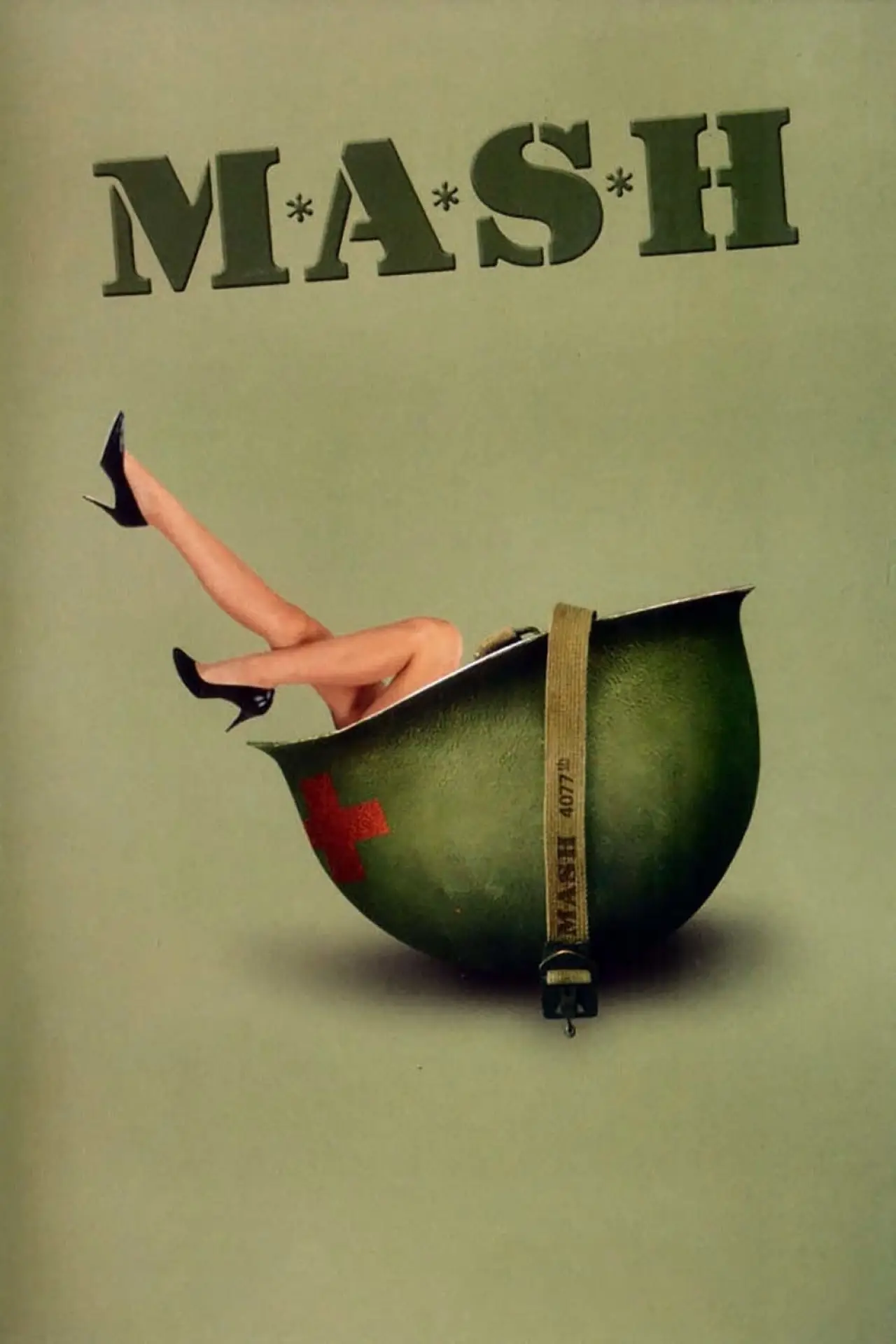
M*A*S*H
M*A*S*H Gives A D*A*M*N.




Country
Budget
$3 500 000
Box office
$81 600 000
Director
Actors
Donald Sutherland, Elliott Gould, Tom Skerritt, Sally Kellerman, Robert Duvall, Roger Bowen, René Auberjonois, David Arkin, Jo Ann Pflug, Gary Burghoff
All actors and roles (10)
All actors and roles (10)
Scenario
Producer
Ingo Preminger, Leon Ericksen
Camera operator
Harold E. Stine
Composer
Johnny Mandel
Artist
Audition
Editing
Danford B. Greene
Whole Team (64)
Whole Team (64)
Short description
One of the world's most acclaimed comedies, M*A*S*H focuses on three Korean War Army surgeons brilliantly brought to life by Donald Sutherland, Tom Skerritt and Elliott Gould. Though highly skilled and deeply dedicated, they adopt a hilarious, lunatic lifestyle as an antidote to the tragedies of their Mobile Army Surgical Hospital, and in the process infuriate Army bureaucrats. Robert Duvall, Gary Burghoff and Sally Kellerman co-star as a sanctimonious Major, an other-worldly Corporal, and a self-righteous yet lusty nurse.
What's left behind the scenes
- When studio executives first saw the footage, they told director Robert Altman that his soldiers looked too dirty compared to the soldiers in, for example, war dramas like "Tora! Tora! Tora!" (1970) by Richard Fleischer (1916-2006), Kinji Fukasaku (1930-2003) and Toshio Masuda, and "Patton" (1970) by Franklin J. Schaffner (1920-1989). Altman himself fought on the front lines of World War II. He replied to the executives that it was war, and soldiers in war didn't actually look pristine. The next day, the studio instructed the producers of those two films to make their soldiers look a little dirtier.
- According to Robert Altman, Elliott Gould and Donald Sutherland jointly complained to studio executives that Altman was devoting too much time and attention to filming minor characters. The actors demanded that the director be replaced, but their request was denied. After the film was released and received critical and audience acclaim, Gould alone admitted this to the director. As a result, he continued to work with Altman, while Sutherland never appeared in another Altman film.
- At the request of 20th Century Fox, a message was added to the opening credits stating that the film takes place in Korea. The Korean War is also mentioned in announcements from loudspeakers and on the radio. And in one scene, it is explicitly stated that the film takes place in 1951—to prevent viewers from assuming that everything is happening during the Vietnam War, which was ongoing when the film was being shot and released.
- The first attempt to film Sally Kellerman (1937-2022) in the shower was unsuccessful because she knew what to expect and lay down on the floor, out of camera view, before the tent flap was raised. To distract the actress, director Robert Altman (1925-2006) and actor Gary Burghoff instructed the camera to be turned on and filming to begin, then both went into the shower tent and simultaneously lowered their pants. At that moment, the tent flap was raised, and Kellerman stood there frozen, with wide-eyed surprise – because Burghoff, beside the camera and off-screen, was standing before her in all his glory.
- Tom Skerritt later recalled that 80% of the lines and dialogue in the film were improvised, as Robert Altman cast people in some roles who had never worked in film or television before.
- One of the innovations devised by Robert Altman was the layering of different dialogues: in some scenes, up to four conversations were heard simultaneously. At the time, this was considered unconventional and even revolutionary, but Altman proved to be right, and the audience agreed with the idea he was trying to convey—that war is "a mess where nothing is ever clear." This technique was subsequently used in some other films as well.
Similar movies

8.6/10

8.2/10

8.2/10
8.2/10
8.1/10
8.1/10
8/10

8/10
7.9/10
7.9/10


 Auditions in India
 Casting calls in USA
 Castingi w Polsce
 Кастинги в Україні
