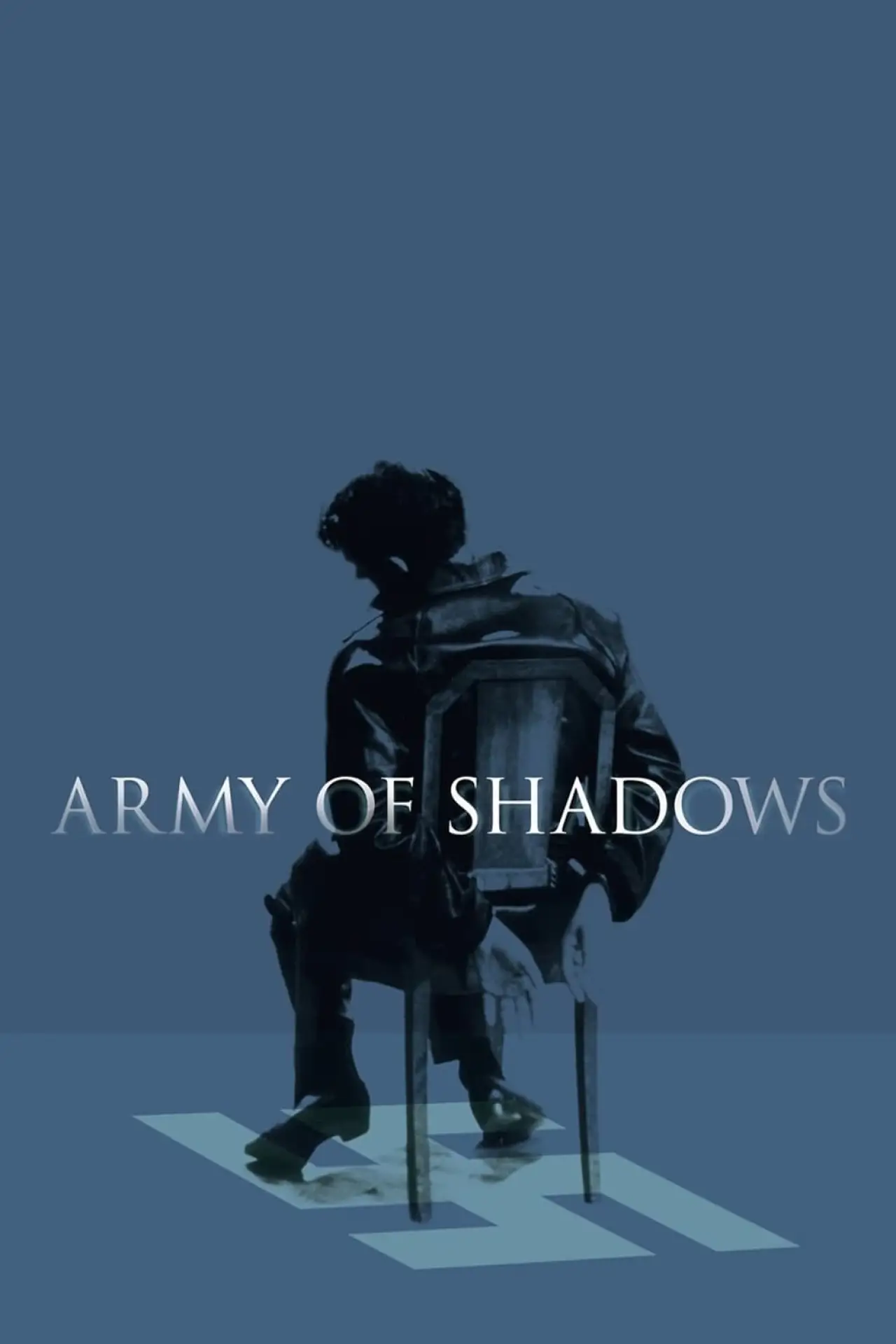
Army of Shadows
Betrayal. Loyalty. Collaboration. Resistance.



![Video for the film Army of Shadows — Official 4K Restoration Trailer [Subtitled]](https://www.acmodasi.com/amdb/images/posters/t/c/mpsVslydw5ha.webp)
Production
Budget
$0
Box office
$810 532
Director
Actors
Lino Ventura, Paul Meurisse, Jean-Pierre Cassel, Simone Signoret, Claude Mann, Paul Crauchet, Christian Barbier, Alain Dekok, Alain Libolt, Jean-Marie Robain
All actors and roles (10)
All actors and roles (10)
Scenario
Producer
Jacques Dorfmann
Camera operator
Composer
Artist
Théobald Meurisse
Audition
Editing
Short description
Betrayed by an informant, Philippe Gerbier finds himself trapped in a torturous Nazi prison camp. Though Gerbier escapes to rejoin the Resistance in occupied Marseilles, France, and exacts his revenge on the informant, he must continue a quiet, seemingly endless battle against the Nazis in an atmosphere of tension, paranoia and distrust.
What's left behind the scenes
- Serge Reggiani also appears in Melville's films for the second and last time. However, if in "Le Doulos" (1962) he played the main role, here he plays only a cameo – a hairdresser, effectively hiding Jervier who has just escaped.
- Ten years before Melville, Ventura and Paul Meurisse already played members of the Resistance – in Julien Duvivier’s drama 'Marie-Octobre' (1959).
- A film adaptation of Joseph Kessel's military novel, published in 1943.
- After restoration, overseen by cinematographer Pierre Lhomme, Rialto Pictures released Melville's long-forgotten film in limited American release in 2006. According to J. Hoberman, almost 40 years after its premiere, the film finally “emerged from the mists of time as an epic tragedy and the apotheosis of the director’s career.” The film grossed $741,733 in the US. The New York Film Critics Association named 'Army of Shadows' the best foreign film of the year.
- General Charles de Gaulle, or rather, his figure in the frame (since we never see his face) was played by Adrien Cayla-Legrand; his name is not listed in the credits.
- The epigraph of the film: “Sad memories – I also welcome you, for you are part of my past.” These are the words of playwright Georges Courteline, but his name is not in the credits.
- Melville said about the film: “Now I have said everything about the war.”
- With “Silence of the Sea” (1949), Melville practically began his career in cinema. Twenty years later, having become famous primarily as a director of crime films, he returned to the theme of war, adapting Joseph Kessel’s autobiographical novel, a former member of the Resistance. He had dreamed of directing “Army of Shadows” for a quarter of a century – since he first read the book.
- In the book, Jean-François learns that his older brother Luc is also a member of the Resistance. He never finds this out in the film.
- The scene of the German march on the Champs-Élysées was supposed to close the film. However, Melville decided to move it to the very beginning.
- Jean-François writes a denunciation against himself in order to end up in the same cell as Félix. This plotline does not exist in the book.
- For the second – and last – time, after 'Le Deuxième Souffle' (1966), Lino Ventura played the leading role in a Melville film.
- After its release, the film was subjected to harsh criticism. Melville was accused of being retrograde and of making a “typically Hollywood propaganda piece.” But for the director, the attitude of the surviving members of the Resistance to the film was more important. During a special screening organized for the author of 'Army of Shadows' and his comrades, Melville carefully watched their reaction. At the end credits, Joseph Kessel could not hold back tears.
Similar movies
8.3/10
8.2/10

8.2/10
8.2/10
8.2/10
8.1/10
8.1/10
8/10
8/10
8/10


 Auditions in India
 Casting calls in USA
 Castingi w Polsce
 Кастинги в Україні
