The Lord of the Rings: The Return of the King
The eye of the enemy is moving.



Country
Production
Budget
$94 000 000
Box office
$1 156 194 180
Website
Director
Actors
Scenario
Producer
Barrie M. Osborne, Peter Jackson, Fran Walsh, Bob Weinstein, Harvey Weinstein, Mark Ordesky, Michael Lynne, Robert Shaye
Camera operator
Composer
Artist
Grant Major, Graham Binding, Jules Cook
Audition
Victoria Burrows, John Hubbard, Liz Mullane
Editing
Short description
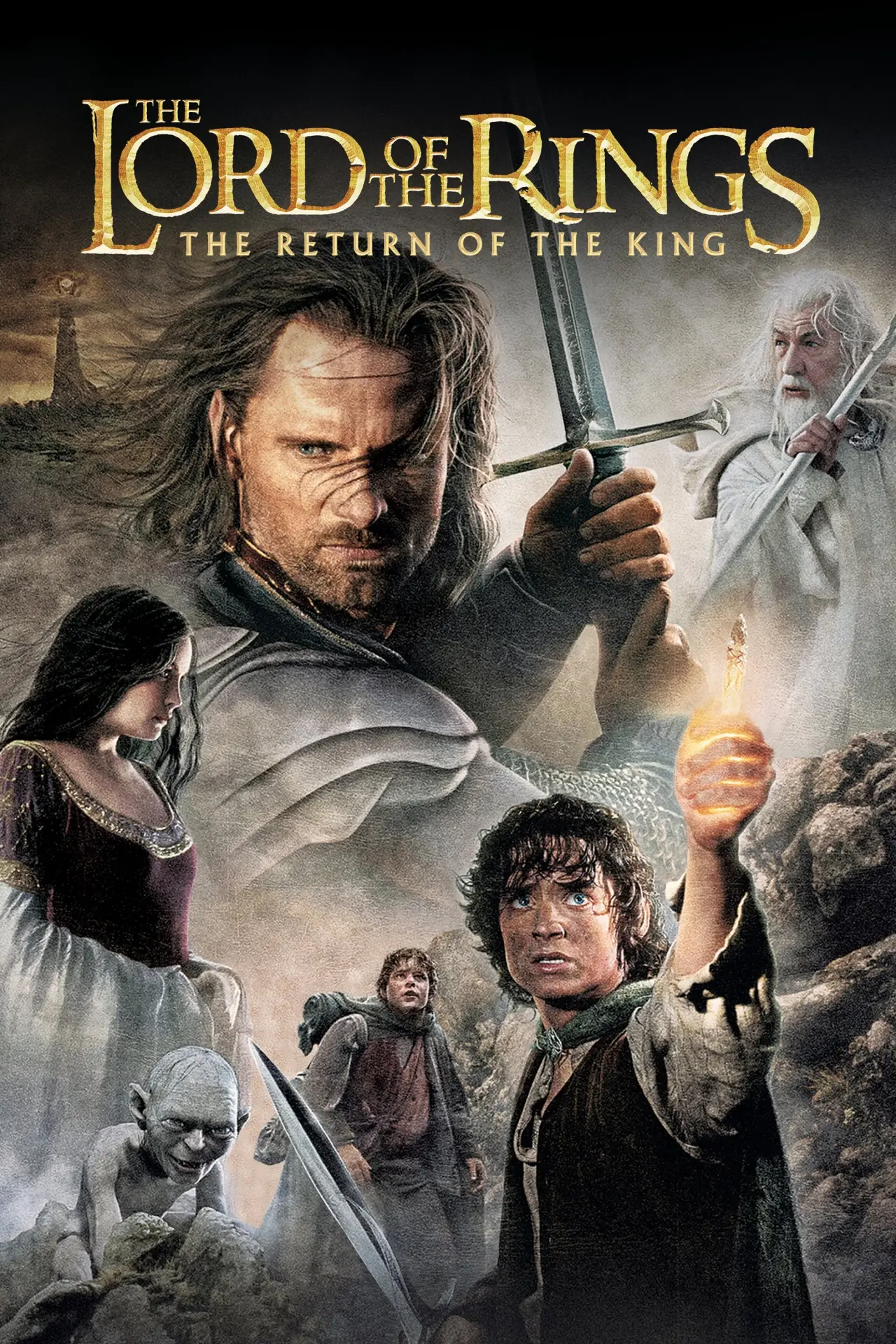
Aragorn is revealed as the heir to the ancient kings as he, Gandalf and the other members of the broken fellowship struggle to save Gondor from Sauron's forces. Meanwhile, Frodo and Sam take the ring closer to the heart of Mordor, the dark lord's realm.
What's left behind the scenes
- For the first time, the Oscar for Best Picture was awarded to a science fiction film. Likewise, for the first time, the director of a sci-fi movie was recognized as the best among his peers.
- The film is based on J.R.R. Tolkien's novel “The Lord of the Rings” (1954-1955).
- Facts and figures: throughout the filming process, 900 km of film stock were used; 48,000 various swords, axes, and other pieces of armor were utilized; 20,600 actors were involved in various crowd scenes; 2,400 staff members were employed (makeup, editing, special effects, sound, etc.); 250 horses were used in one of the scenes; there were 114 speaking roles (characters who spoke at least a couple of lines in the film); 30 actors learned non-existent languages and dialects; and it took the creators 7 years to complete the entire trilogy.
- During the scriptwriting process for the trilogy, Peter Jackson originally envisioned 26-year-old Stuart Townsend to play the role of Aragorn. After 6 weeks of preparation, a decision was made to find an older actor. As is well known, Viggo Mortensen, aged 41, was cast.
- Facts and figures: 900 km of film were used during the entire filming process; 48,000 of all kinds of swords, axes and other armor were used; 20,600 actors were involved in various mass scenes; 2,400 personnel (makeup, editing, special effects, sound, etc.); 250 horses were used in one of the scenes; 114 character roles (characters who say at least a couple of lines in the film); 30 actors learned nonexistent languages and dialects; it took the creators 7 years to complete the entire trilogy.
- The first scene of the film, which explains Gollum's origin, was originally intended to be part of the second movie, "The Lord of the Rings: The Two Towers" (2002).
- A new international box office record was set—the film earned a colossal sum of 250 million during its opening weekend.
- There are two edited versions: the theatrical version—shortened to meet the requirements of US distributors and shown in cinemas and on television; and the Special Extended Edition (SEE)—which is 50 minutes longer than the theatrical version.
- The Lord of the Rings trilogy received the most Oscar nominations (30), surpassing such titans as The Godfather (28) and Star Wars (21).
- For only the second time in cinema history, the Academy has awarded the top prize to a sequel (previously, The Godfather Part II (1974) received the award). It matched the record previously set by Ben-Hur (1959) and Titanic (1997) — 11 Oscar awards.
- The number of computer special effects increased from installment to installment. If 560 were used in the first part, then 800 in the second, and as many as 1500 in the final one.
- For the first time, an Oscar for Best Picture went to a fantasy film. And for the first time, a fantasy film director was recognized as the best among his peers.
- Viggo Mortensen became so immersed in his role that he sometimes even outside of filming calmly responded to the name Aragorn.
- All 11 of the film's nominations were converted into awards. This is an absolute record. Previously, The Last Emperor (1987) and Gigi (1958) had won 9 out of 9.
- The film became the most-watched film of 2017 on the streaming platform Netflix. It topped the charts thanks to a Canadian resident who watched the blockbuster 361 times during her pregnancy. Suria-Anne Jones watched the director's cut of the film, which lasts 4 hours and 23 minutes.
- The film is based on J.R.R. Tolkien's novel "The Lord of the Rings" (1954-1955).
- All 11 nominations for the film resulted in awards. This is an absolute record. Previously, "The Last Emperor" (1987) and "The Seventh Seal" (1958) had won 9 out of 9 nominations.
- It is one of the longest films to ever win an Oscar (201 minutes). However, Gone with the Wind (1939) lasted as long as 238 minutes.
- One of the longest films to win an Academy Award (201 minutes). However, the film Gone with the Wind (1939) lasted as long as 238 minutes.
- The Lord of the Rings trilogy received the most Academy Award nominations (30), surpassing such titans as The Godfather (28) and Star Wars (21).
- The number of computer special effects increased from one installment to the next. While 560 were used in the first part, there were 800 in the second, and as many as 1,500 in the final one.
- The battle scenes, which according to the creators involved around 200,000 virtual characters, required a vast amount of processing time. Weta Digital, the studio responsible for the effects, was even forced to build a new equipment room because a colossal amount of hardware was needed to process the imagery.
- Viggo Mortensen became so immersed in his role that he would sometimes respond to the name Aragorn even when off-camera.
- The first scene of the film, which explains the origin of Gollum, was originally intended to be included in the second film – “The Lord of the Rings: The Two Towers” (2002).
- All three parts of the trilogy were filmed simultaneously.
- The battle scenes, in which the creators claim approximately 200,000 virtual characters participated, required a huge amount of processing time. Weta Digital, responsible for the effects, was even forced to build a new room for equipment, as a colossal amount of hardware was needed to process the images.
- In February 2004, the film became the second in the history of cinema to gross over a billion dollars (the pioneer was "Titanic" (1997)).
- A new international record for box office collections was set – the film grossed a colossal $250 million during its opening weekend.
- For the second time in the history of cinema, the main prize of the Academy Awards has been given to a sequel (previously, "The Godfather Part II" (1974) received the award). The record previously set by "Ben-Hur" (1959) and "Titanic" (1997) – 11 Oscar awards – has been repeated.
- During the scriptwriting process for the trilogy, Peter Jackson originally intended for 26-year-old Stuart Townsend to play the role of Aragorn. After six weeks of preparatory work, it was decided to find an older actor. As is well known, that person was 41-year-old Viggo Mortensen.
- There are two editing versions: theatrical release version – shortened to meet the requirements of US distribution companies, shown in cinemas and on television; special extended edition (SEE) – 50 minutes longer than the theatrical version.
- In February 2004, the film became the second in cinematic history to gross over one billion dollars (the pioneer being Titanic (1997)).
Similar movies
8.8/10
8.8/10
8.5/10

8.2/10
8.1/10
8.1/10
8/10

8/10
7.9/10
7.9/10


 Auditions in India
 Casting calls in USA
 Castingi w Polsce
 Кастинги в Україні
