The Silence of the Lambs
To enter the mind of a killer she must challenge the mind of a madman.




Country
Production
Budget
$19 000 000
Box office
$272 742 922
Director
Actors
Scenario
Producer
Ronald M. Bozman, Edward Saxon, Kenneth Utt, Gary Goetzman
Camera operator
Composer
Artist
Kristi Zea, Gary Kosko, Natalie Wilson
Audition
Howard Feuer
Editing
Craig McKay
Whole Team (138)
Whole Team (138)
Short description
Clarice Starling is a top student at the FBI's training academy. Jack Crawford wants Clarice to interview Dr. Hannibal Lecter, a brilliant psychiatrist who is also a violent psychopath, serving life behind bars for various acts of murder and cannibalism. Crawford believes that Lecter may have insight into a case and that Starling, as an attractive young woman, may be just the bait to draw him out.
What's left behind the scenes
- Anthony Hopkins was given 24 minutes and 52 seconds of screen time, which did not prevent him from winning an Academy Award for Best Actor.
- In the film, Jayme is sometimes referred to as James, and sometimes by the feminine name Jamie. In the book, children teased him about his name as a child, which contributed to his transgender identity.
- During preparation for filming, Jodie Foster and Scott Glenn were provided with audio recordings made by serial killers during the murders they committed. Jodie flatly refused to listen to these chilling recordings, but Scott, unfortunately, decided to, and as a result, he was plagued by nightmares for a considerable time.
- During preparation for his role, Anthony Hopkins carefully studied files on the most famous serial killers of our time. He also visited prisons where these individuals were held and even attended a couple of high-profile trials.
- Michelle Pfeiffer turned down the lead role, citing concerns that the film would be quite bloody and violent. After that, Jonathan Demme decided to invite Jodie Foster to the project, and as it turned out, he made the right decision.
- Brooke Smith, who played the kidnapped girl Catherine, and Ted Levine, who played Buffalo Bill, were very close during the filming of the movie.
- During one of the scenes in the solitary confinement cell, Anthony Hopkins tried to look directly into the camera, justifying this action by the fact that this angle would give the audience the impression that his character “knows absolutely everything.”
- Despite all his crimes, Ted Bundy assisted in solving a whole series of murders. Ted was executed on January 24, 1989, but the killer was not found until 2001 – 12 years after Bundy's execution. He turned out to be Gary Ridgway, who confessed to 48 crimes.
- In December 2011, the film was included in the U.S. National Film Registry as having significant cultural, historical, or aesthetic value.
- Screenwriter Ted Tally, while creating the script for the film, saw only Jodie Foster in the role of Agent Starling. However, when Jonathan Demme took the director's chair, he decided to change the choice of his predecessors and invited Michelle Pfeiffer to the film.
- The maniac known as Buffalo Bill was created as a composite image of three real-life serial killers. So, let's meet these terrifying individuals, each responsible for the deaths of at least fifty people: Ed Gein, who liked to flay the skin off his victims, the handsome Ted Bundy, who used a fake arm cast to attract naive women, and Gary Heidnik, who enjoyed keeping his victims in a deep pit where they usually died of starvation.
- In addition to Hackman, Robert Duvall, Jeremy Irons and Brian Cox also auditioned for the role of Dr. Lecter.
- The main motif of the plot had parallels with real events, namely the relationship between Professor of Criminology Robert Keppel and the serial killer Ted Bundy.
- While studying video footage, Anthony noticed that the maniac Charles Manson never blinked during conversations, and immediately transferred this observation to the screen.
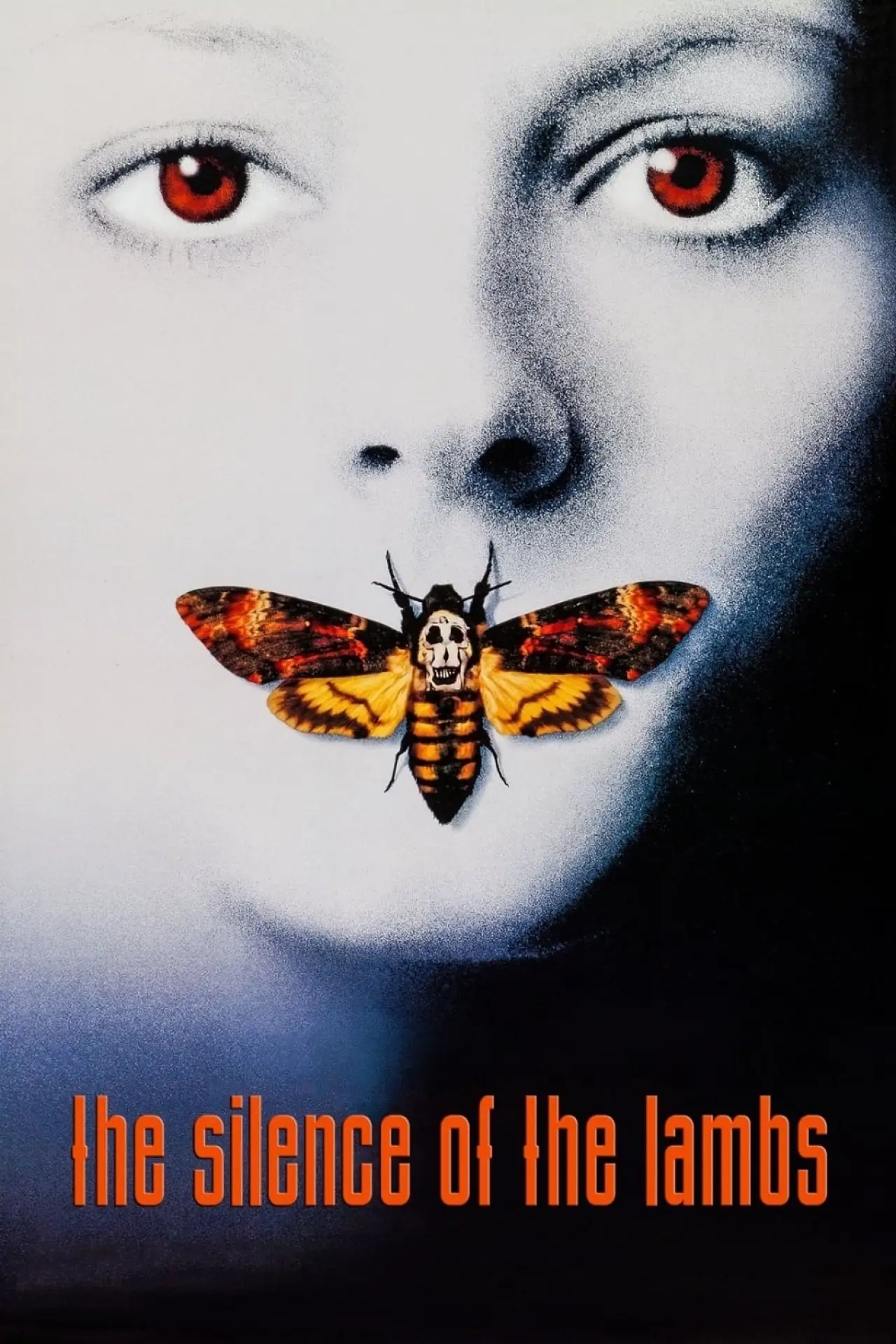
- If you look closely at the poster, you can see an image of a skull on the body of a butterfly. And if you look even more closely, you can make out that the skull consists of at least three nude women (there are versions of the poster where you can count up to seven women).
- Anthony Hopkins, describing the voice he gave Hannibal Lecter, called it a symbiosis of the voices of Truman Capote and Katharine Hepburn.
- The film is based on Thomas Harris' novel 'The Silence of the Lambs' (1988).
- During their first meeting, Dr. Lecter hinted at where to find Buffalo Bill. He described a drawing he had made on the wall of his solitary confinement cell: “It’s called the Duomo—I saw the painting in Belvedere, Italy.” Later, Starling learns that Buffalo Bill lives in Belvedere, Ohio.
- Anthony Hopkins, describing the voice given to his character Hannibal Lecter, called it a “symbiosis of Truman Capote and Katharine Hepburn.”
- The role of Hannibal Lecter was offered to Gene Hackman, who was also offered to direct. At the same time, Michelle Pfeiffer and Meg Ryan were considered for the role of Clarice.
- The man in the blue cap in the final scene of the film is director Jonathan Demme, who played a cameo role in his own movie.
- Initially, the plan was to release the film in the fall of 1990. However, Orion Pictures decided to hold the release until January 1991, in order not to create competition for another of their hits, "Dances with Wolves," which also participated very successfully in the Oscar race.
- Most of the footage was shot in Pittsburgh. The city was ideal for filming due to the abundance of architectural structures and other beautiful locations. This allowed the film crew to create the illusion that filming took place in different parts of the country.
- This film became the third in the history of the Academy Awards to win all 5 major awards: “Best Picture,” “Best Director,” “Best Actor,” “Best Actress,” and “Best Screenplay.” Previously, the same honors were bestowed upon “It Happened One Night” (1934) and “One Flew Over the Cuckoo's Nest” (1975).
Similar movies
9.2/10
9/10
8.8/10
8.6/10
8.6/10
8.3/10
8.2/10
8.1/10
8.1/10
8/10


 Auditions in India
 Casting calls in USA
 Castingi w Polsce
 Кастинги в Україні
