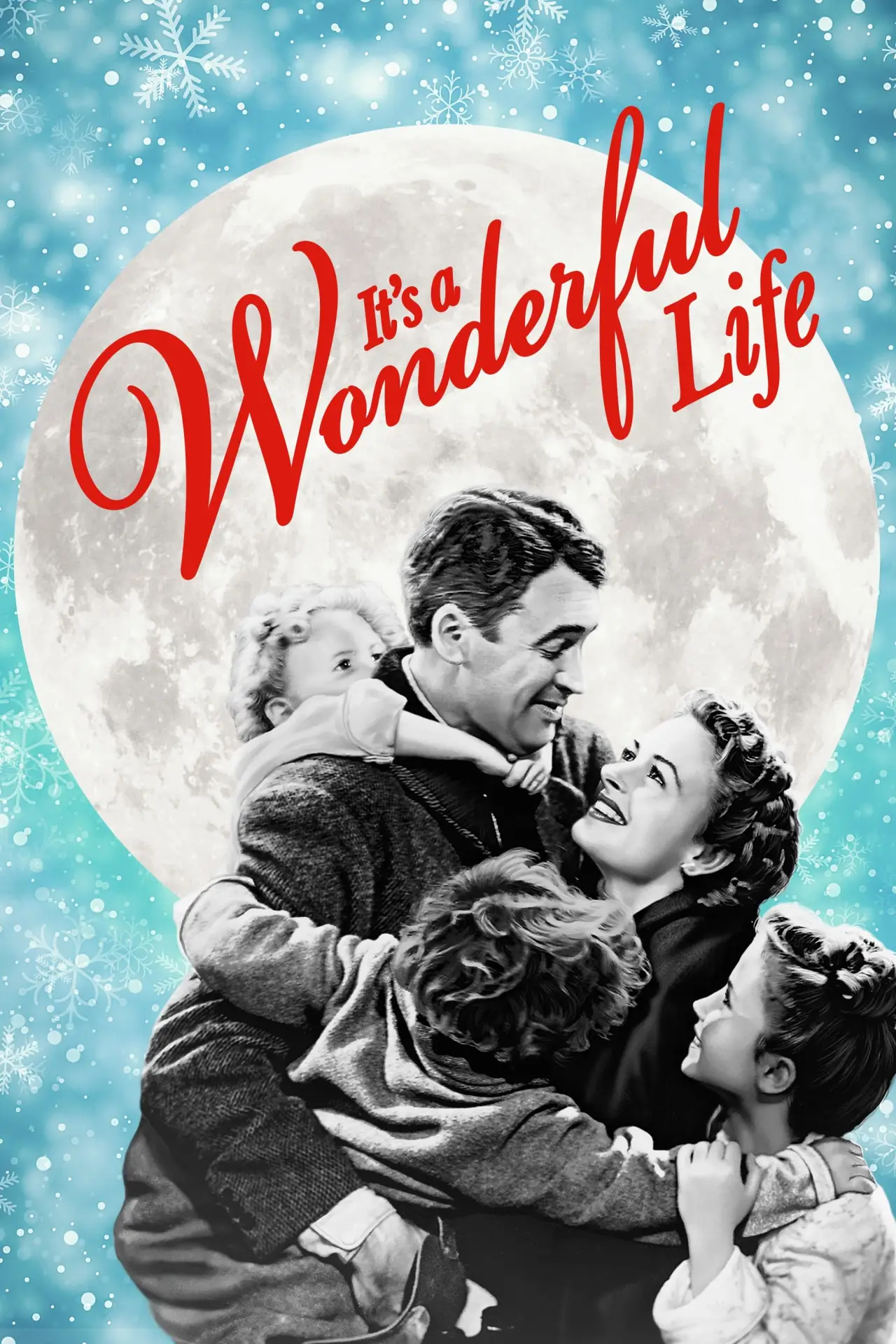
It's a Wonderful Life
It's a wonderful laugh! It's a wonderful love!




Country
Production
Budget
$3 180 000
Box office
$9 644 124
Director
Actors
Scenario
Producer
Camera operator
Joseph F. Biroc
Composer
Artist
Audition
Editing
William Hornbeck
Whole Team (27)
Whole Team (27)
Short description
George Bailey has spent his entire life giving to the people of Bedford Falls. All that prevents rich skinflint Mr. Potter from taking over the entire town is George's modest building and loan company. But on Christmas Eve the business's $8,000 is lost and George's troubles begin.
What's left behind the scenes
- In one scene, Donna Reed (1921-1986) was required to break a window with a stone, and director Frank Capra (1897-1991) hired a sniper to shoot the window on cue. To everyone's surprise, Reed broke the window herself. She had played baseball in school, so she had a good throwing arm.
- The film's plot unfolds around Christmas time, but it was filmed in the height of summer heat. At one point, the heat became so unbearable that Frank Capra had to declare a day off.
- Sam makes a fortune on plastic products, and Harry becomes an engineer at his father-in-law's glass factory. Both of these circumstances reflect the past of director Frank Capra himself. He was originally trained as a chemical engineer. Unable to find work in his field, he – like the hero of this film – considered himself a failure for many years.
- The scene on the bridge where Clarence saves George was filmed on an outdoor set when the temperature was below 30 degrees Fahrenheit. That's why James Stewart appears to be sweating in some scenes.
- Since the 1970s, the film has been regularly shown on major US television channels on Christmas Eve.
- James Stewart was very worried about the kissing scene, as it was his first on-screen kiss after returning from the war to Hollywood. They decided to film it without rehearsals. Stewart played the scene so well on the first take that the passionate embrace accompanying the kiss had to be cut due to censors.
- The entire gym hall slides apart, revealing a swimming pool below. This scene was filmed at a school in the Beverly Hills area, which – along with the swimming pool – is still in operation today.
- When the drunken character of Thomas Mitchell (1892-1962) exits the house, judging by the sounds, he stumbled over garbage cans on the sidewalk. In reality, someone on the set dropped an entire tray of props just as Mitchell walked out of frame. Stewart burst out laughing, to which Mitchell replied, “I’m okay,” which was not in the script. Director Frank Capra decided to leave this take in the film and gave the person who dropped the tray $10 as a bonus.
- The Bedford Falls town set took two months to build and became one of the longest sets in the history of American cinema. It covered 4 acres of RKO Studios land. It included the storefronts of 75 shops and other buildings, a central street, an industrial area, a large residential area, and a slum district. The central street was over 250 meters long and spanned three city blocks.
- The audience is left unaware of Mr. Potter's fate after he accuses George of embezzling $8,000 that Uncle Billy mistakenly slipped into Mr. Potter’s newspaper. This was rather unusual for the time, as the so-called “Hays Code” (the ethical code of film production in Hollywood) required that the guilty party either face punishment or repent in the film's finale.
- Before filming this movie, falling snow on screen was depicted using white-painted cornflakes. Their fall was quite noisy, so the dialogue had to be recorded afterward and dubbed onto the footage. Director Frank Capra wanted to record the sound live, so they began 'making' snow for the filming using foamite (a fire-extinguishing foam compound), soap, and water. Afterwards, for filming silent snowfall, the resulting mixture was passed through a wind machine under high pressure. Over 22,000 liters of the new compound were used for filming this movie. The American Film Academy awarded the special effects department of RKO Pictures a prize for inventing the new snow compound for filming.
- Director Frank Capra paid close attention to every shot. In a key scene in the film, a desperate George sits in a bar and prays to God to save him. By that time, James Stewart (1908-1997), who played the role, was already close to a breakdown, had a fit, and burst into tears. Capra did not expect this at all, and the cameras were set up at a decent distance from the actor. Stewart's emotions impressed the director so much that he asked the actor to play the scene exactly the same way again so he could film it in close-up. Stewart refused, saying that the tears were not acted, but real. Ultimately, Capra took the film to a laboratory, where he endlessly cut and enlarged frames until he got a close-up. This is why this scene looks so “grainy” compared to all the other scenes in the film.
Similar movies
7.9/10
7.9/10

7.8/10
7.8/10
7.8/10
7.6/10
7.5/10
7.5/10
7.5/10
7.5/10


 Auditions in India
 Casting calls in USA
 Castingi w Polsce
 Кастинги в Україні
