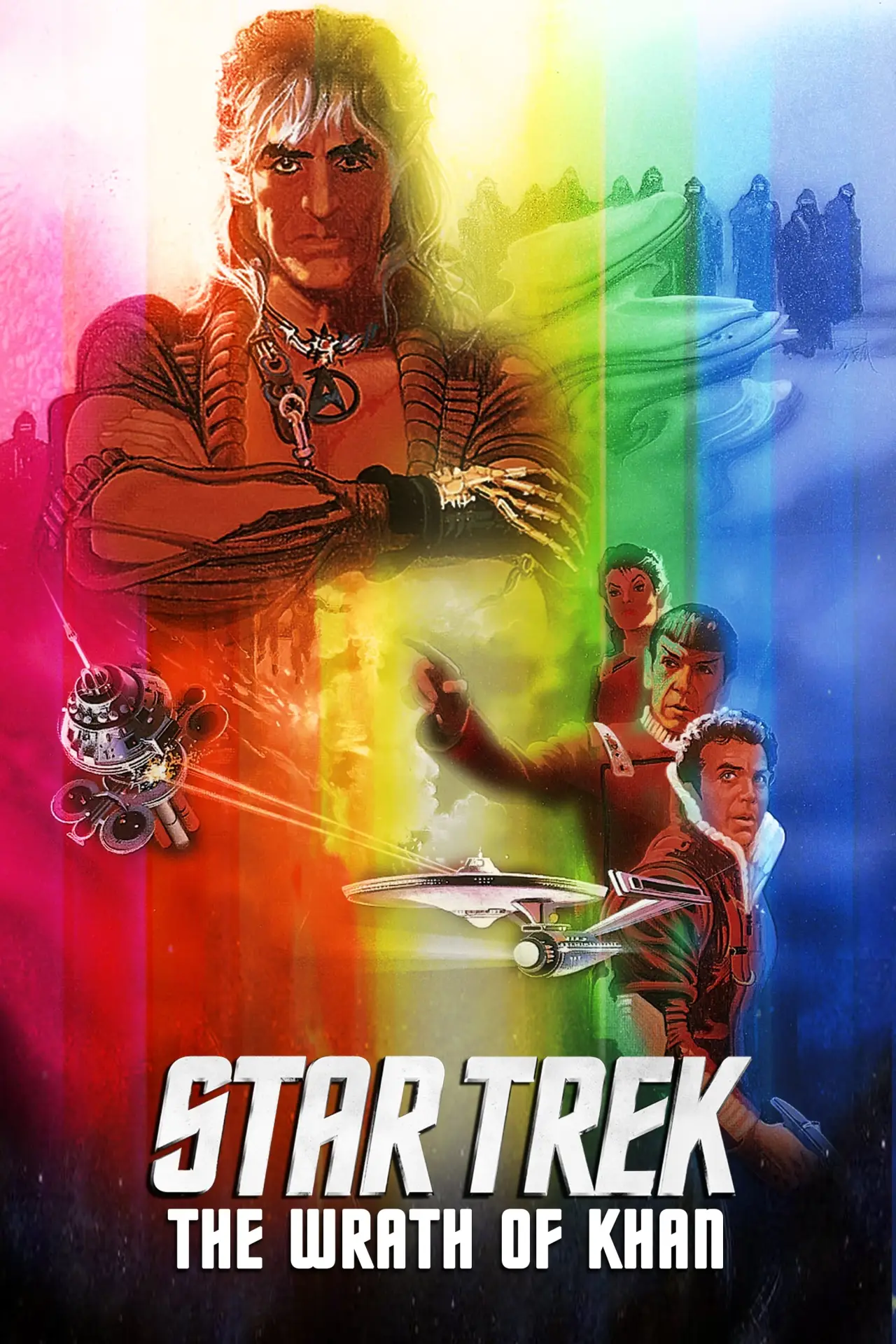
Star Trek II: The Wrath of Khan
At the end of the universe lies the beginning of vengeance.




Country
Production
Genre
Budget
$11 200 000
Box office
$78 912 963
Director
Actors
Scenario
Producer
Robert Sallin, Harve Bennett
Camera operator
Gayne Rescher
Composer
Artist
Joseph R. Jennings
Audition
Mary V. Buck
Editing
William Paul Dornisch
Whole Team (96)
Whole Team (96)
Short description
It is the 23rd century. The Federation Starship U.S.S. Enterprise is on routine training maneuvers and Admiral James T. Kirk seems resigned to the fact that this inspection may well be the last space mission of his career. But Khan is back. Aided by his exiled band of genetic supermen, Khan - brilliant renegade of 20th century Earth - has raided Space Station Regula One, stolen a top secret device called Project Genesis, wrested control of another Federation Starship and sets out in pursuit of the Enterprise, determined to let nothing stand in the way of his mission: kill Admiral Kirk... even if it means universal Armageddon.
What's left behind the scenes
- Captain Kirk and Khan never meet face-to-face throughout the entire film. They communicate only via screen connection. This is because all scenes with Ricardo Montalbán (1920-2009), who played Khan, were filmed separately due to his busy schedule.
- As soon as Ricardo Montalbán (1902-2009) agreed to appear in the film, he realized it would be difficult to reprise the role of Khan. He had already become “stuck” in the image of Mr. Roarke, whom he had played for many years in the series “Fantasy Island” (1977-1984). The actor requested a copy of the “Space Seed” (1967) episode from the series “Star Trek” (1966-1969) from Paramount Pictures and watched it several times. After the third or fourth viewing, he began to regain an understanding of the essence of the character he was to play.
- As a child, Kirstie Alley was fascinated by the series “Star Trek” (1966-1969). Her favorite character was Spock, and she often imagined herself as his daughter. During the audition for the role of Saavik, she played as Leonard Nimoy (1931-2015) played her beloved Spock.
- Executive producer Harvey Bennett (1930-2015) re-watched the entire series “Star Trek” (1966-1969) and chose the “Space Seed” (1967) episode as the basis for the sequel. The script even includes a line from Spock suggesting it would be interesting to return here in 100 years to see what civilization has emerged. This was the first time a specific episode of a series served as the basis for a feature film.
- The filming used a huge rubber mockup of Walter Koenig's ear, who played Chekov.
- Gene Roddenberry (1921-1991), the creator of the entire 'Star Trek' universe, served as a consultant on this film, while Harvey Bennett fulfilled the duties of executive producer. Paramount Studios accused Roddenberry himself of constant delays and budget overruns while working on the 1979 adventure film 'Star Trek: The Motion Picture' (Robert Wise, 1914-2005), constantly interfering with the process and insisting on changes to the plotlines. The studio had no objections to him becoming a producer alongside John Povill, but Roddenberry persisted, demanding complete creative freedom and the right to make decisions.
- The transformation of an uninhabitable planet into a habitable one (and vice versa) using 'Genesis' was the first scene in cinema created entirely through computer technology. This was made possible by programmer Loren Carpenter, formerly of Boeing.
- Producers chose Ricardo Montalbán for the role of Khan, believing he would be available for filming and happy to reprise the character. No one considered any other options, even though Montalbán was filming 'Fantasy Island' at the time, forcing the filmmakers to schedule filming around his television work.
- Captain Kirk and Khan never meet face-to-face throughout the entire movie; they communicate only via screen link. This is because all scenes featuring Ricardo Montalbán (1920-2009), who played Khan, were filmed separately due to his scheduling constraints.
- As soon as Ricardo Montalbán (1902-2009) agreed to appear in the film, he realized that playing Khan again would be difficult. He had become 'stuck' in the persona of Mr. Roarke, whom he played for many years in the series 'Fantasy Island' (1977-1984). The actor requested a copy of the 'Space Seed' (1967) episode of 'Star Trek' (1966-1969) from Paramount Pictures and watched it several times. After the third or fourth viewing, he began to regain an understanding of the essence of the character he was to portray.
- As a child, Kirstie Alley was fascinated by the series "Star Trek" (1966-1969). Her favorite character was Spock, and she often imagined herself as his daughter. During her audition for the role of Saavik, she acted in the same way Leonard Nimoy (1931-2015) played her beloved Spock.
- Executive producer Harve Bennett (1930-2015) rewatched the entire "Star Trek" series (1966-1969) and chose the episode "The Omega Glory" (1967) as the basis for the sequel. Its script even contains a line from Spock suggesting it would be nice to return in 100 years to see what civilization had emerged. This was the first time a specific series episode served as the basis for a feature film.
- The producers chose Ricardo Montalbán for the role of Khan, assuming he would be available for filming and happy to play the character again. No one considered any other options, even though Montalbán was filming "Fantasy Island" at the time; consequently, the filmmakers had to adjust the shooting schedule so it would not conflict with Montalbán's work on the series.
- A huge rubber model of the ear of Walter Koenig, who played Chekov, was used during filming.
- Gene Roddenberry (1921-1991), the creator of the entire "Star Trek" universe, served as a consultant for this film, while Harve Bennett acted as executive producer. Paramount Pictures had blamed Roddenberry himself for constant filming delays and budget overruns during the production of the 1979 adventure film "Star Trek: The Motion Picture" (Robert Wise, 1914-2005), as he constantly interfered in the process and insisted on changing plotlines. The studio did not object to him becoming a producer alongside John Povill, but Roddenberry persisted, demanding full creative freedom and decision-making authority.
Similar movies
8.6/10
8.6/10
8.3/10
8.1/10
8.1/10

8/10
8/10
7.8/10
7.7/10
7.7/10


 Auditions in India
 Casting calls in USA
 Castingi w Polsce
 Кастинги в Україні
