Empire of the Sun
To survive in a world at war, he must find a strength greater than all the events that surround him.




Country
Production
Budget
$35 000 000
Box office
$22 238 696
Director
Actors
Scenario
Producer
Camera operator
Composer
Artist
Norman Reynolds, Gavin Bocquet, Miguel Chang
Audition
Editing
Short description
Jamie Graham, a privileged English boy, is living in Shanghai when the Japanese invade and force all foreigners into prison camps. Jamie is captured with an American sailor, who looks out for him while they are in the camp together. Even though he is separated from his parents and in a hostile environment, Jamie maintains his dignity and youthful spirit, providing a beacon of hope for the others held captive with him.
What's left behind the scenes
- The film is based on J.G. Ballard's autobiographical novel “Empire of the Sun” (1984).
- Warner Bros. acquired the film rights almost immediately after the book was published. Harold Becker was to direct, and Robert Shapiro was to produce. The first draft of the screenplay was written by British playwright and screenwriter Tom Stoppard in close collaboration with James Ballard himself.
- After Harold Becker left the project, David Lean took his place, and Steven Spielberg became one of the producers. After working on it for about a year, David Lean resigned for creative reasons, and Steven Spielberg finally took his place. Menno Meyjes was brought in to refine the script, after which Tom Stoppard was brought back to write the final version.
- The film was shot in the Elstree Studios pavilions in England, as well as in Spain and China. Negotiations with Chinese cultural authorities began in 1985 and continued with varying success for almost a year. Ultimately, permission was granted to film in Shanghai and its surroundings for three weeks in March 1987. It was the first American film to be shot in Shanghai since the 1940s.
- For the duration of the filming in Shanghai, Chinese authorities allowed for the replacement of a number of road signs and indicators, and the temporary closure of entire blocks. Over 5,000 local residents were used as extras, some of whom may still have remembered the terrible period of Japanese occupation.
- Japanese soldiers in the film were played by active members of the Chinese People's Liberation Army.
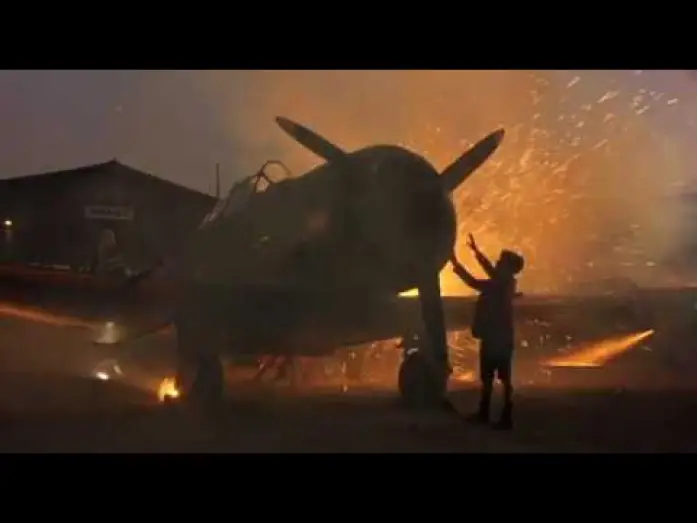
- To achieve maximum authenticity, Steven Spielberg sought to use cars and aircraft from that period. At his disposal were three full-scale, accurate replicas of Japanese Mitsubishi A6M Zero fighters and three restored American The North American Aviation P-51 Mustang fighters that arrived from the United Kingdom. Due to the complexity of the planned flight scenes, filming with their participation took a full ten days. Large-scale, specially recreated models of aircraft were also used, but the resulting footage often did not satisfy the director.
- Tom Danaher, who played Colonel Marshall, was a fighter pilot during World War II in the Pacific. He also piloted one of the Japanese Mitsubishi A6M Zero fighters in the film. Actor Robert Stevens later stated in an interview that much of his role was cut during editing. James McGann made the same claim.
- Mark Rylance could have been cast in one of the roles in the film.
- Over 4,000 boys auditioned for the lead role in the film. The director was personally recommended to pay attention to Christian Bale by his wife at the time, Amy Irving. She remembered him from his role as Tsarevich Alexei in the television series “Anastasia: The Mystery of Anna,” where they had filmed together previously.
- Eric Flynn, who played one of the British prisoners of war, was actually held in a Japanese internment camp as a child.
- The part of the film taking place in the internment camp was significantly cut during editing. As a result, the roles of some actors were practically eliminated.
- The role in the film was the last for British veteran actor Ralph Michael.
- Ben Stiller, who played one of his first roles in the film, stated that the idea for 'Tropic Thunder,' filmed twenty years later, came to him during the filming process.
- The author of the book, James Graham Ballard, appears in a cameo at the beginning of the film as one of the participants in a masquerade ball.
- Some scenes of the film were shot in Trebujena (Andalusia), Natsford (Cheshire), and Sunningdale in Berkshire.
- The title song of the film, Suo Gân, is a traditional Welsh lullaby of unknown authorship. Steven Spielberg chose it because the young Christian Bale, who played the main role, was originally from Wales.
Similar movies
8.7/10
8.4/10
8.3/10

8.2/10
8.2/10
8.1/10

8.1/10
8.1/10
8/10
7.9/10


 Auditions in India
 Casting calls in USA
 Castingi w Polsce
 Кастинги в Україні
